Top MD lawmakers echo Obama's clean energy call with major jobs bill in Annapolis

Contact:

Tiffany Hartung, Maryland Climate Coalition, o:(443) 759-3402, c: (248) 933-2451, hartungt@nwf.org
Kelly Trout, Chesapeake Climate Action Network, o:(240)396-2022, c: (717) 439-0346, kelly@chesapeakeclimate.org

Top MD Lawmakers Push for Clean Energy Expansion and Record-Large Jobs Bill on First Day of General Assembly

2016 legislation would boost wind and solar while building a diverse workforce, fulfilling President Obama’s State of the Union call to “invest in the future”

ANNAPOLIS—On the first day of the 2016 Maryland General Assembly session, state legislators joined clean energy advocates on Lawyers’ Mall to push for legislation that would significantly boost Maryland’s use of renewable energy, while creating the largest clean energy jobs training program in state history.

The Maryland Clean Energy Jobs Act of 2016 will ensure Maryland gets 25 percent of its electricity from clean sources like wind and solar by 2020, up from the current goal of 20 percent by 2022. It includes a $40 million plan to train and prepare more Marylanders for careers in clean energy and to bolster minority- and women-owned businesses within the clean energy economy.

Influential lawmakers—including the chairs of key House and Senate committees—joined today’s press conference with solar industry and environmental leaders, and dozens of climate activists. Large blown-up photos depicted the benefits of the bill, from cleaner air and healthier children to job training in underserved communities to reduced emissions of climate-disrupting pollution.

“We’ll grow Maryland’s clean energy economy in a way that increases the diversity of workers and business owners,” said Senator Catherine Pugh, Senate Majority Leader. “As we create more than 1,000 new solar jobs per year, we’ll also give more Marylanders pathways to good-paying careers.”

“2016 is the year to pass the Clean Energy Jobs Act and invest in Maryland’s future by bringing more solar, more wind, and more jobs to our communities,” said Senator Brian Feldman, the lead Senate sponsor of the bill.

“This bill will ensure fast-growing industries create more jobs right here in Maryland,” said Delegate Bill Frick, the lead House sponsor of the bill.

“Expanding our state’s clean energy use and growing our state economy go hand in hand,” added Delegate Dereck Davis, chair of the House Economic Matters Committee. “We’re talking about thousands of new Maryland solar jobs that pay an average of $23 per hour, and new industries that could stimulate more Maryland manufacturing and construction.”

“I look forward to passing the Clean Energy Jobs Act out of my committee so we can keep Maryland at the forefront of clean energy,” said Senator Mac Middleton, chair of the Senate Finance Committee.

“This is a win-win-win for our economy, our environment, and our health in Maryland,” said Senator Rich Madaleno, vice-chair of the Senate Budget & Taxation Committee. “The climate benefits alone will be equal to taking 563,000 cars off the road each year. Cleaner air will mean fewer cases of asthma, healthier families, and reduced health care costs for the state.”

Expanding Maryland’s Renewable Portfolio Standard to 25 percent will create incentives for roughly 1,300 new megawatts of clean energy. Plummeting solar and wind prices and abundant, untapped renewable assets position the state to easily achieve this higher goal at little to no cost to ratepayers, according to preliminary results of a study commissioned by industry leaders.

“Solar companies like mine now employ more than 3,000 workers across Maryland, in large part due to strong state policies,” added Tony Clifford, CEO of Standard Solar. “We’ll see more solar businesses and a larger pool of qualified workers to hire as a result of the Clean Energy Jobs Act.”

The legislation creates a Clean Energy Workforce Account to provide job training in the clean energy sector targeted to areas of the state with high unemployment. It also establishes a Clean Energy Business Development Fund to help minority and women-owned businesses enter and grow within the clean energy economy. This workforce development plan would tap $40 million of unallocated contributions to Maryland’s Strategic Energy Investment Fund.

“I’m moving up the career ladder in clean energy thanks to training programs that gave me in-demand skills,” said Jarrell Henry, an energy auditor with Hawkeye Construction in Baltimore City. “Since graduating from Civic Works’ Baltimore Center for Green Careers in 2012, and gaining additional certifications, I’ve been promoted to crew leader and now to energy auditor. More Marylanders deserve these same opportunities.

“This bill is a top priority for Maryland’s environmental community,” said Karla Raettig, director of the Maryland League of Conservation Voters and member of the Maryland Climate Coalition. “It will reduce harmful greenhouse gas emissions, which are causing rising sea levels, record storms, and increased flooding across Maryland.”

Advocates are using the hashtag #CleanerMDnow to distribute information about the 2016 legislation.

###
The Maryland Climate Coalition brings together environmental, faith, health, labor, and civic organizations to advance clean energy and climate policies in Maryland.  For more information about the Maryland Climate Coalition, visit http://www.marylandclimatecoalition.org.

2016 VA General Assembly Preview: It Was Not A Coastal Event

We built a movement. Two years ago, CCAN unveiled a new campaign with a singular focus: highlight the urgent need for solutions to flooding and climate change in at-risk areas of Virginia. Over the past two years, CCAN supporters and partnering organizations have advanced our Safe Coast Virginia campaign and turned our top priority legislation, the Virginia Coastal Protection Act (VCPA), into one of the most talked-about climate bills in the state.
We’re not done yet. On Wednesday, the General Assembly convenes for the 2016 legislative session and passage of the VCPA is our main goal. Republican delegate Ron Villanueva and democratic senator Donald McEachin have reintroduced a bill that is badly needed in order to help solve the crisis of flooding in Virginia that is fueled by climate change.
The bill has seen an evolution of late – for the better. In September of last year, Gov. McAuliffe declared a state of emergency for an impending weather event that wreaked havoc in many communities along the east coast – and could’ve been much worse. A McAuliffe administration official said that the severe rain event that caused millions of dollars in damages throughout the commonwealth “was not a coastal event.” Homes in every part of the state were affected by this storm and more homes will be at risk in the future due to climate change.
When this campaign first began, CCAN helped shed light on the significant costs associated with sea level rise along the coast. By now, we all know that the cost to help Hampton Roads adapt to sea level rise is in the billions of dollars. These figures are far too great for localities to bear themselves. What has become increasingly clear is that climate change is fueling severe flooding events throughout the state with more frequency, making communities incredibly vulnerable in every part of the state.
The reintroduced version of the VCPA will provide revenues to localities throughout the state to assist with flooding and climate resilience efforts. I’m proud to have gained the support of the Virginia Municipal League, an organization representing localities throughout the state, who has enthusiastically endorsed the VCPA as a solution to flooding and climate change and will work for its passage. In addition, individual localities from Staunton to Leesburg to Virginia Beach have stepped up to support the VCPA.
There are other bills that we’ll be following this year as well. We’re going to hold legislators accountable for attempts to stall on climate progress by delaying implementation of the Clean Power Plan. We will continue to fight for strengthened clean energy laws and promote the expansion of solar, wind, and efficiency programs as we have successfully done in the past few years. And we will monitor efforts by gas companies to accelerate development of natural gas infrastructure which leads to devastating local and climate impacts.
But one of the biggest challenges facing our lawmakers this session is how to secure the massive amount of resources necessary to begin implementing solutions to sea level rise in Hampton Roads and flooding from severe rain events in localities throughout Virginia. Our elected leaders can take a step forward on climate and begin addressing this problem by passing the VCPA in a few short weeks.
We’ll keep you posted on the VCPA’s progress and other climate-related bills as they make their way through the legislative process in Richmond.

In the wake of Paris, over 6,000 Virginians call on Governor McAuliffe: Save Our Coast!

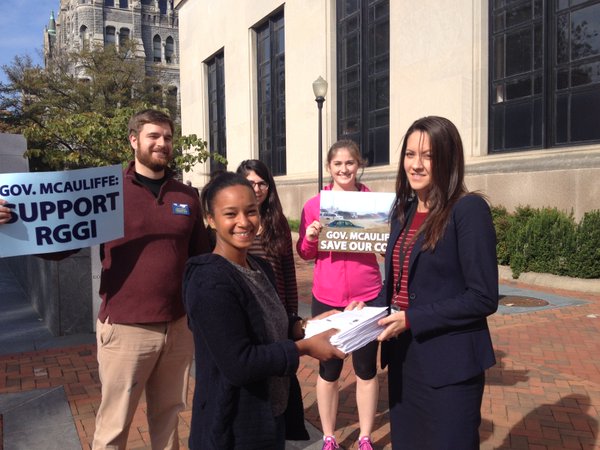
Today, the Chesapeake Climate Action Network delivered over a thousand petitions to Governor Terry McAuliffe, demanding action on climate and a plan to save our coast from rising seas.

Delivery to Angela
Volunteers deliver petitions to Governor McAuliffe’s Deputy Secretary of Natural Resources, Angela Navarro

Today’s delivery is part of a growing call for climate action in Virginia – one that has grown especially loud in the wake of world leaders taking action in Paris last week.
Over the last six weeks, with help from our partners at the Virginia Sierra Club, Appalachian Voices, Virginia Organizing, Environment Virginia, New Virginia Majority and the Virginia Conservation Network, we’ve delivered our 6,000 petitions – from moms, students, business owners, flooding victims and other concerned Virginians across the state – to the Governor, urging him to act on climate and save our coast by supporting the Regional Greenhouse Gas Initiative (RGGI), a regional system that caps and reduces carbon pollution.
save our coast rain boots
Coastal residents stand with Delegate Ron Villanueva at a waterside press conference launching the Virginia Coastal Protection Act of 2016

Meanwhile, a bipartisan bill that would direct Virginia to join RGGI has gained unprecedented support since it was introduced last spring. The bill, called the Virginia Coastal Protection Act, introduced by Delegate Ron Villanueva (R-Virginia Beach) and Senator Donald McEachin (D-Richmond), would not only cap and reduce Virginia’s carbon pollution, it would also create the first statewide fund to help our communities deal with the impacts of climate change.
City governments across the state – including Virginia Beach, Norfolk, Hampton, Newport News, Fredericksburg, Leesburg, Staunton and Charlottesville – support Virginia joining RGGI.
The powerful Virginia Municipal League and Hampton Roads Planning District Commission both support Virginia joining RGGI.
Virginia’s major newspapers – the Richmond Times-Dispatch and the Virginian Pilot – support Virginia joining RGGI, as does the Washington Post.
Businesses from Hampton Roads to the Valley support Virginia joining RGGI.
Climate groups, environmental groups, fair housing groups, health groups and justice groups support Virginia joining RGGI.
keep carbon in the ground
A candelight vigil at the General Assembly on the eve of the last day of the Paris climate talks

And just last week, nearly 50 people gathered at the General Assembly to mark the end of the Paris climate talks and call on Governor McAuliffe to keep carbon in the ground.
Over the last six weeks, we’ve made it clear that 6,000 Virginians and counting support Virginia joining RGGI too.
Now, the question is: what is Governor McAuliffe going to do?
So far, Governor McAuliffe has refused to support this win-win solution, while remaining stubbornly supportive of a spiderweb of fracked gas pipelines across our farms and forests and offshore drilling along our coast.
Here at CCAN, we know that the actions we take now will help determine how high sea levels rise along our coast and how extreme the weather gets in all of our communities.
Given what’s at stake, it’s more than time for Governor McAuliffe to follow the leadership of world leaders, join this rising tide of support and put his weight behind Virginia joining RGGI. In the wake of Paris, this is the most important step we can take to advance bold climate action here at home.
 

Climate Activists Deliver Nearly 6,000 Petitions Urging Governor McAuliffe to Take Bold Action to ‘Save Our Coast’

For Immediate Release: December 22, 2015

Contact: Monique Sullivan, 202-440-4318, monique@chesapeakeclimate.org

Regional carbon-cap program would provide first dedicated state funds for flood protection

RICHMOND—In the wake of historic climate progress out of Paris, and just a day after Governor Terry McAuliffe released his final climate commission report, climate activists urged Governor McAuliffe to pick up the pace on climate action and endorse a bipartisan plan that would jump-start solutions to rising sea levels and flooding.
Activists from more than half a dozen groups have delivered 1,000 petitions every week since just after this fall’s elections, and will make the final delivery to the Governor’s offices in Richmond today – totaling nearly 6,000 from across the state. They are calling on Governor McAuliffe to throw his weight behind adding Virginia to the Regional Greenhouse Gas Initiative (RGGI), a nine-state system that caps and reduces carbon emissions from power plants. The move would significantly reduce Virginia’s emissions of greenhouse gases while generating about $250 million per year to invest in flood-protection measures and promote statewide climate solutions.
“Given dangerous flooding is already a routine threat along our coast, Virginia must pick up the pace on climate action. The governor’s recommendations are a good start, and should be implemented without delay. But make no mistake, more action is needed to fully address climate change in Virginia. We need to move as quickly as possible to a renewable energy economy, while helping localities deal with the impacts of sea level rise and flooding that are here now.
“This is the most important next step Governor McAuliffe can take to advance bold climate action in Virginia,” said Monique Sullivan, Field Director at the Chesapeake Climate Action Network. “City governments across Virginia and now thousands of ordinary moms, students, business owners, teachers, and coastal citizens all agree: the time to act is now.”
Bipartisan legislation that would move Virginia into the RGGI program — the Virginia Coastal Protection Act — has gained support from a broad coalition of city governments and environmental, health, housing and justice advocates across the state over the past year. The latest endorsements have come from the Virginia Municipal League, the Hampton Roads Planning District Commission, and the city councils of Virginia Beach, Hampton, Newport News and Fredericksburg.
“We’re counting on Governor McAuliffe to do the right thing for our coast and our climate and throw his weight behind this win-win solution,” added Sullivan. “The Governor’s climate commission recommendations are a good start, but he can’t stop there. Virginia’s flood-prone communities need help now, and joining this regional carbon-cap program is our best solution at the state level.”
Groups participating in the petition drive include the Chesapeake Climate Action Network, the Virginia Student Environmental Coalition, Virginia Sierra Club, Appalachian Voices, Virginia Conservation Network, Environment Virginia, New Virginia Majority, Virginia Organizing, and Environmental Action.
Read more about the petition delivery and the growing support for Virginia joining the RGGI program at: http://chesapeakeclimate.org/blog/in-the-wake-of-paris-over-6000-virginians-call-on-governor-mcauliffe-save-our-coast/

###

The Chesapeake Climate Action Network is the biggest and oldest grassroots organization dedicated to fighting climate change in Virginia, Maryland, and Washington, DC. CCAN is building a powerful movement to shift our region away from climate-harming fossil fuels and to clean energy solutions: www.chesapeakeclimate.org.

Governor’s Climate Report Moves Va. Forward, But More Action Is Needed

As water rises and flooding worsens, McAuliffe can take immediate action by backing bipartisan climate legislation in the 2016 General Assembly

RICHMOND—On the heels of a landmark global agreement to step up action on climate change, Governor Terry McAuliffe today released the final report of his Virginia Climate Change and Resiliency Commission.
The report recommends a number of steps that Virginia can take to move toward clean energy and reduce greenhouse gas pollution—including establishing a green bank for energy efficiency and renewable energy investments, setting a renewable energy procurement target for the state government, and encouraging widespread use of electric vehicles.
Dawone Robinson, Virginia Policy Director at the Chesapeake Climate Action Network, had the following statement in response:
“Given dangerous flooding is already a routine threat along our coast, Virginia must pick up the pace on climate action. The governor’s recommendations are a good start, and should be implemented without delay. But make no mistake, more action is needed to fully address climate change in Virginia. We need to move as quickly as possible to a renewable energy economy, while helping localities deal with the impacts of sea level rise and flooding that are here now.
“Virginia must significantly reduce our carbon footprint from power plants and make smarter energy choices to fight climate change. In the coming months, as the governor prepares his plan to comply with the Clean Power Plan, we must dramatically lower carbon emissions from all power plants in Virginia by investing in renewable energy and energy efficiency.
“One practical solution to climate change that has yet to receive the governor’s endorsement is the passage of the Virginia Coastal Protection Act. Republican Delegate Ron Villanueva and Democratic Senator Donald McEachin have led the way by introducing this bipartisan bill. The bill would create the first statewide fund to help communities deal with flooding impacts by adding Virginia to the nine-state Regional Greenhouse Gas Initiative. By committing his support, Governor McAuliffe can help bring $250 million to Virginia per year to help combat flooding and promote clean energy.”
Contact:
Mike Tidwell, 240-396-2022, mtidwell@chesapeakeclimate.org
Monique Sullivan, 240-396-2153, monique@chesapeakeclimate.org

###

CCAN Statement: Vote to Lift the Oil Export Ban Puts Baltimore at Greater Risk

For Immediate Release
December 18, 2015
Contact:
Jon Kenney, 240-396-1985, jon@chesapeakeclimate.org
Kelly Trout, 240-396-2022, kelly@chesapeakeclimate.org

CCAN Statement: Vote to Lift the Oil Export Ban Puts Baltimore at Greater Risk

In response to the budget deal passed by Congress that would lift the 40-year crude oil export ban, Jon Kenney, Healthy Communities Organizer for the Chesapeake Climate Action Network, released the following statement:
“For Big Oil, Christmas came early. On the heels of historic international climate progress, the Obama administration and Congress have caved to the pressure of companies like Exxon, lifting a 40-year ban on exporting crude oil overseas. With Congress failing to protect our communities from oil trains, it’s even more critical that the Baltimore City Council steps up.
“Put simply, lifting the oil export ban incentivizes the extraction of more fossil fuels. This means more fracking in places like North Dakota, more explosive crude oil trains rolling through cities like Baltimore, and more climate pollution. A recent study estimated that the new oil drilled to meet overseas demand could produce as much annual greenhouse gas pollution as 135 coal-fired power plants, and could put an additional 4,500 explosive crude oil trains on railroad tracks every day.
“What does this mean for our region? In Baltimore, we’re concerned that even more explosive crude oil trains could roll through the heart of the city, putting the 165,000 people who live within a mile of the tracks at even greater risk. Crude oil trains are already rolling through Baltimore, even as we lack a comprehensive understanding of the health and safety impacts.

In response to today’s harmful vote in Congress, the Baltimore City Council can and should introduce a city ordinance requiring health and safety impact studies of oil trains, which they’ve promised to do in January. Our communities deserve to know what’s at stake as millions of gallons of toxic and flammable crude oil travels by schools, churches, hospitals, businesses, the Inner Harbor, and even City Hall.
“The evidence is in: to protect ourselves from the impacts of climate change, and the myriad health and safety dangers of extracting and transporting fossil fuels, we must keep most of remaining oil reserves in the ground. That means that the Obama administration can’t be hailing climate progress in Paris while Congress simultaneously sends a signal to the oil industry to extract more fossil fuels. This isn’t a trade off we can make any longer.”

###
The Chesapeake Climate Action Network is the biggest and oldest grassroots organization dedicated to fighting climate change in Maryland, Virginia and Washington, DC. CCAN is building a powerful movement to shift our region away from climate-harming fossil fuels and to clean energy solutions: www.chesapeakeclimate.org.

CCAN Responds to Latest Scandal in Mayor Bowser’s Exelon-Pepco Deal

2016-CCAN protests Exelon takeover in DC

WAMU reports Exelon hired FreshPAC chairman to lobby Mayor’s office days before ‘settlement’ was reached

See the article here: http://wamu.org/news/15/12/16/exelon_paid_freshpac_chair_to_lobby_DC_government_about_merger
Statement in response from Mike Tidwell, director of the Chesapeake Climate Action Network:

“I have never seen such a blatant appearance of political corruption in my entire career as a consumer and environmental advocate. The ‘P’ in FreshPAC stands for political. Exelon brazenly hired the chairman of the Mayor’s own political action committee to pressure the Mayor to knuckle under to a bad deal for consumers and the environment. This is absolutely outrageous. This is all about corrupt politics and consumer rip-off.
“This comes after the ‘soccergate’ scandal in September, when Pepco gave $25 million to the Mayor for vague naming rights related to her soccer stadium deal. This comes after Pepco and Exelon still refuse to confirm or deny whether the Mayor’s super PAC asked them to make direct political donations. It comes after the Mayor’s office pressured the federal General Services Administration to drop its opposition to the settlement. Now this.
“How shocking does this bad-government process have to become before the Mayor gains some pride and withdraws from this fraudulent ‘settlement’?”

More on the “Soccergate” scandal: http://www.powerdc.org/soccergate.html
More on the Mayor’s bad settlement deal: http://www.powerdc.org/settlement-facts.html
Contact:
Mike Tidwell, CCAN director, 240-460-5838
Kelly Trout, 240-396-2022, kelly@chesapeakeclimate.org

###

Bipartisan Virginia Leaders Push for Major 2016 Bill to Combat Flooding, Fund Climate Solutions

Innovative approach would help cities adapt and promote clean energy while reducing carbon pollution; action builds on current climate talks in Paris

NORFOLK—A bipartisan group of Virginia leaders gathered in Norfolk today to push for passage of comprehensive state legislation in the 2016 General Assembly to combat the local impacts of flooding and promote clean energy solutions. They highlighted the need for local action on climate change even as world leaders meet in Paris to bolster global commitments.
The bill, called the Virginia Coastal Protection Act, would generate about $250 million per year to invest in flood-protection measures, as well as energy efficiency, clean energy and job training programs. It would do so by adding Virginia to a regional market-based system that caps and reduces carbon pollution.
In recent months, city governments across the state—including Virginia Beach, Hampton, Newport News, Norfolk, Fredericksburg, and Staunton—and the Virginia Municipal League have endorsed the bill as a 2016 priority.
Republican State Delegate Ron Villanueva of Virginia Beach joined coastal city officials and the former commanding officer of Naval Station Norfolk for a waterside press conference this morning to announce introduction of the bill into the 2016 General Assembly with Democratic Senator Donald McEachin of Richmond.
“The Virginia Coastal Protection Act is the best path forward to protect flood-prone communities while combating climate change and growing our economy,” said Delegate Villanueva. “With so many homes, businesses, and military assets at risk from rising seas, the urgent need for action is clear. This bill unlocks hundreds of millions of dollars to kick-start practical solutions.”
“This year, I will be re-introducing legislation that will reduce carbon emissions while helping localities to combat flooding and impacts from sea level rise,” said Senator McEachin.
Some activists wore bright yellow rain boots to dramatize the struggle many coastal citizens already face in getting to work or school amidst high tides or heavy storms. Experts say the city of Norfolk alone needs $1 billion to adapt to encroaching waters. Severe weather events—such as heavy rainfall that washed out roadways in Southwest Virginia in late September—are causing increasingly costly damage across Virginia.
“It’s time to create the state’s first dedicated funding source to help localities along the coast and beyond deal with the impacts of climate change,” said Virginia Beach City Councilmember Rosemary Wilson, past president of the Virginia Municipal League and a current member of VML’s Legislative Committee. “This is a win-win policy with the support of cities across Virginia.”
The benefits of the bipartisan climate bill would extend far beyond flood protection. Under the legislation, Virginia would join a system called the Regional Greenhouse Gas Initiative (RGGI) that has a track record of lowering greenhouse gas emissions while lowering utility bills in nine states from Maine to Maryland. Virginia would be poised to meet its requirements under the federal Clean Power Plan while gaining new revenue—about $250 million per year through 2030—to support climate resilience and economic development.
The Virginia Coastal Protection Act would direct a full half of the funds generated to help localities throughout the state combat flooding caused by sea-level rise and severe weather. The second-largest portion of funds would support energy efficiency programs that save consumers money. Additional funds would promote solar power and support jobs programs for families and businesses in Southwest Virginia.
Retired Navy Captain Joe Bouchard joined today’s press conference to urge the General Assembly to act on this comprehensive climate plan for another reason: national security.
“Virginia’s response to climate change impacts the readiness of the world’s largest Naval base,” said Bouchard, who is a former commanding officer of Naval Station Norfolk. “The Navy could spend hundreds of millions of dollars protecting the base from sea level rise; but it cannot function if the cities around it are crippled by rising waters.”
“Adapting to the impacts here now must go hand in hand with transitioning to clean energy solutions,” added Bouchard. “That is the Defense Department’s strategy, and it is the right strategy for Virginia, too.”
The Virginia Coastal Protection Act has gained a broad array of support since its original introduction in the 2015 General Assembly. The Virginia Housing Coalition, the Virginia Chapter of the American Association of Pediatrics, Virginia Organizing, the Union of Concerned Scientists, and all of Virginia’s statewide environmental groups have called for its passage. The editorial boards of the Virginian-Pilot, the Washington Post, and the Richmond Times-Dispatch have all penned pieces in support of its regional carbon-cutting approach.
“From Paris to Richmond, the actions we take now will determine how high the water goes and whether our communities are able to stay safe,” said Dawone Robinson, Virginia policy director at the Chesapeake Climate Action Network. “In 2016, the General Assembly and Governor McAuliffe must take action. Virginia can do our part to lower emissions, in a way that saves consumers money, creates new jobs, and brings real resources to communities facing dangerous flooding now.”
A fact sheet on the Virginia Coastal Protection Act is available at: http://chesapeakeclimate.org/wp-content/uploads/2015/01/2016-CCAN-VA-Coastal-Protection-Act-Factsheet.pdf
An overview of the benefits of Virginia joining the Regional Greenhouse Gas Initiative is available at: http://chesapeakeclimate.org/wp-content/uploads/2014/03/VA-RGGI-Fact-Sheet-UPDATED-8.10.15.pdf
Contact:
Kelly Trout, 240-396-2022, kelly@chesapeakeclimate.org
Dawone Robinson, 804-767-0372, dawone@chesapeakeclimate.org

###

In Spirit of Paris, Top Maryland Lawmakers Propose Largest Clean Energy Jobs Plan in State History

2016 bill will expand wind and solar while creating good-paying jobs and a diverse clean energy workforce

ANNAPOLIS—As world leaders meet in Paris to marshal global climate action, top Maryland lawmakers came together in Annapolis today to unveil their plan to create the largest dedicated clean energy jobs and business development program in state history.
As part of 2016 legislation to significantly expand Maryland’s use of renewable electricity, Senate Majority Leader Catherine Pugh (D-Baltimore) and Delegate Dereck Davis (D-Prince George’s) are proposing a $40 million plan to train and prepare more Marylanders for careers in clean energy and to bolster minority- and women-owned businesses within the clean energy economy.
The lawmakers announced the plan, called the 2016 “Clean Jobs Act,” during a press conference on Lawyers’ Mall alongside Senator Rich Madaleno, Maryland small business, community college, and job training leaders, and climate advocates.
“Maryland needs to increase our renewable energy standard to 25 percent while putting in place funding to increase the diversity of business owners and workers,” said Sen. Pugh, who sits on the Senate Finance Committee. “The Clean Jobs Act will give more Marylanders the opportunity to thrive in the growing clean technology sector and put cities like Baltimore on the forefront of clean energy development.”
“2016 is the year to pass this ‘Clean Jobs Act’ for Maryland,” said Del. Davis, chair of the House Economic Matters Committee. “This bill will sustain an estimated 2,000 additional clean energy jobs right here in Maryland. The average Maryland solar installer earns nearly $23 per hour. Greater workforce development investments can direct those jobs where they’re needed most, while unlocking the full talent of our state’s clean energy entrepreneurs.”
Senator Brian Feldman and Delegate Bill Frick of Montgomery County are lead sponsors of the legislation to expand Maryland’s Renewable Portfolio Standard (RPS). Sen. Pugh and Del. Davis will join Senator Mac Middleton, chair of the Finance Committee, and Senator Rich Madaleno, vice-chair of the Budget and Taxation Committee, as co-sponsors of the bill in 2016.
“I’m proud to sponsor this legislation because addressing climate change and improving our economy go hand in hand,” said Sen. Brian Feldman. “It’s time to lock in Maryland as a leader in both.”
The legislation would ensure that Maryland gets 25 percent of its electricity from clean sources like wind and solar power by 2020, up from the state’s current goal of 20 percent by 2022. By creating incentives for roughly 1,300 megawatts of new clean energy, the bill would significantly improve Marylanders’ air quality and reduce greenhouse gas emissions, which are causing rising sea levels, record storms, and increased flooding.
“Maryland’s solar industry now employs over 3,000 workers, and the industry expects to grow 26 percent this year, adding 750 more jobs,” said Del. Frick. “In 2016, it’s time to speed up this growth while providing better training to more Maryland workers.”
“Climate change solutions—like cleaner, more efficient energy—mean healthy air and healthy people who can go to work and support their families,” said Sen. Madaleno. “All Marylanders deserve clean air to live healthier and more meaningful lives.”
Maryland has met its existing renewable energy standard every year since the RPS program was first implemented in 2005. Maryland now ranks among the top solar states in the nation. Plummeting solar and wind prices and abundant, untapped renewable assets — from sunny rooftops to blustery Eastern Shore farmland — position the state to easily achieve a higher goal. Collectively, Maryland’s policies to address climate change are expected to create 26,000 to 33,000 new jobs and grow wages by tens of billions of dollars by 2020, according to state data.
The new workforce development plan within the RPS bill would tap $40 million of unallocated contributions to Maryland’s Strategic Energy Investment Fund. Part of the funding would provide pre-apprenticeship job training in the clean energy sector targeted to areas of the state with high unemployment. Bolstering existing job training programs at Maryland community colleges is one example of how the funds could be put to work.
Gregory Mason, Vice President of Business and Continuing Education at Baltimore City Community College, also spoke at today’s press conference: “Not only is more renewable energy critical to preserving our natural resources, but it also offers a foot in the door for our students to begin and advance careers within a well-paid, burgeoning industry.”
Additional funding would establish a Clean Energy Business Development Fund to help minority- and women-owned businesses enter and grow within the clean energy economy in Maryland.
“We started our business in Maryland in part because of its commitment to expanding clean energy technologies,” said Daniel Wallace, director of Technical Sales for BITHENERGY. “The Clean Jobs Act will significantly enhance the economic imperatives that are necessary for clean energy companies like ours to thrive and to create jobs.”
Today’s announcement adds to growing momentum for climate action in Maryland. Over the past year, legislation to expand Maryland’s RPS law gained support from a broad base of faith, labor, health, social justice, and environmental constituencies — including the NAACP, Maryland Working Families, SEIU, seven Maryland bishops and top ecumenical leaders. Meanwhile, in late October, the state’s bipartisan Climate Change Commission voted unanimously in support of extending and strengthening Maryland’s statutory goal for reducing greenhouse gas emissions.
“While world leaders gather in Paris at the biggest global climate summit of this decade, Maryland leaders are stepping up to put concrete solutions into motion,” said Mike Tidwell, director of the Chesapeake Climate Action Network and member of the Maryland Climate Coalition. “Our clean electricity standard is our state’s top program for reducing climate pollution. By increasing it, we can build a more just and sustainable economy while doing our part to reduce greenhouse gas emissions.”
A memo on the proposed $40 million workforce development plan is available at: http://chesapeakeclimate.org/wp-content/uploads/2015/12/Maryland-Clean-Jobs-Plan-Workforce-and-MBE-Memo.pdf
A fact sheet on the benefits of expanding Maryland’s renewable energy standard is available at: http://chesapeakeclimate.org/wp-content/uploads/2015/12/MCC_Forward-with-Clean-Energy_25percent_120715.pdf
Photos from today’s press conference are available for use at: https://www.flickr.com/photos/chesapeakeclimate/albums/72157661471776619

###

Contact:
Kelly Trout, 240-396-2022 (office), kelly@chesapeakeclimate.org
James McGarry, 914-563-2256 (cell), james@chesapeakeclimate.org

Fredericksburg, Leesburg pass resolutions in support of RGGI

In the final two week of November, the city of Fredericksburg and the town of Leesburg both passed resolutions in support of the Virginia Coastal Protection Act. The votes came on the heels of a number of cities in the Hampton Roads, including Hampton and Virginia Beach, that have also voted to support the bipartisan legislation to allow Virginia to join the Regional Greenhouse Gas Initiative (RGGI).
RGGI is a cooperative effort among nine east state from Maine to Maryland that caps and reduces their emissions from power plants. Under RGGI, power plants in participating states purchase allowances for every ton of carbon pollution that they emit. Virginia could receive as much as $209 million annually from the proceeds from the the allowances, which would be directed towards climate-related flooding mitigation, energy efficiency, renewable, and economic development in southwestern Virginia.
With the General Assembly session just around the corner, momentum is building once again for the Virginia Coastal Protection Act. Last year, the bill narrowly failed to make its way out of the Senate Agriculture, Conservation, and Natural Resources Committee. The bipartisan patrons of last year’s bill, Del. Ron Villanueva (R-Virginia Beach) and Sen. Donald McEachin (D-Richmond), are expected to reintroduce the legislation in the coming weeks.
This time around we’ve built an even broader and more diverse coalition of supporters. Businesses large and small, as well as, housing advocates and social justice organizations are all on board. Scientists are saying that 2015 is well on its way to being the warmest year on record, and we need solutions for coastal Virginia now.
As we approach General Assembly session in January, we will need your help to pass the Virginia Coastal Protection Act. You can find out how to get involved by emailing me at Charlie@chesapeakeclimate.org.