
Skip to content

Climate Docket Dispatch

The Public Service Commission regulates the District’s utilities – Pepco and Washington Gas – and has the power to make or break our climate commitments. Read on for CCAN’s Docket Dispatch to learn about the live “dockets” at the Commission and see if our regulators are keeping up with the task. 

Docket 1179

Project Pipes / District (un)SAFE

Docket 1180

Washington Gas Rate Case

Docket 1167

Gas Planning

Docket 1182

Electric Planning

Docket 1179: Accelerated Pipeline Replacement – also known as Project Pipes or District (un)SAFE

Washington Gas’s ongoing accelerated pipeline replacement project is a massive, $12 billion dollar plan to replace every methane gas pipe in the city – whether it needs it or not. Rather than targeting dangerous and polluting methane leaks, the program focuses on replacement based on pipe material, an imperfect model in which fully functional pipes are replaced all the time – and gas customers foot the bill. In the past ten years, it’s led to no reduction in gas leaks in the District. Yet Washington Gas champions this program, as this method of wholesale pipe replacement is far more profitable to Washington Gas, and more expensive to customers, than modern technologies for repairing leaking pipes.
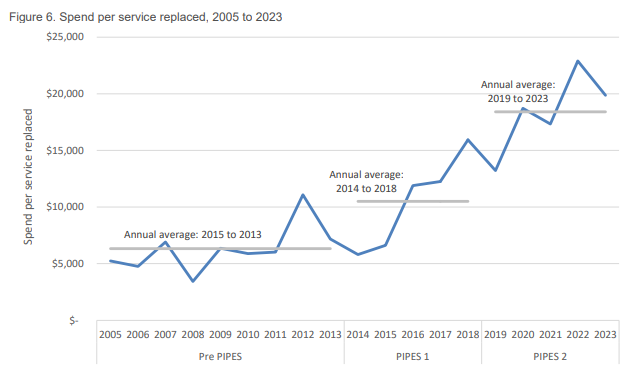
Source: https://ccanactionfund.org/media/source-spend-per-service.pdf

In docket 1179, the Public Service Commission is considering District (un)SAFE – Washington Gas’s latest $215 million proposal for the third phase of its accelerated pipeline replacement program. This proposal requests 43% more than any previous phase, which means if approved, gas bills – also known as “rates” – would increase for everyone who pays them.

End of 2025 Update

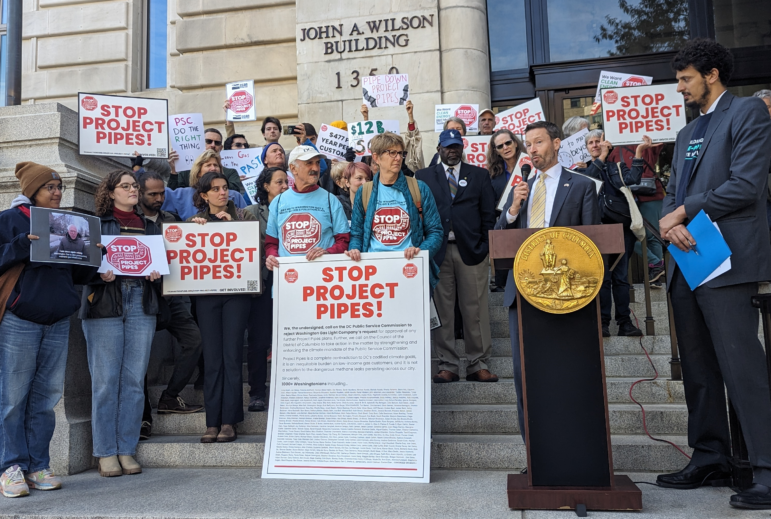
Deliberations on District (un)SAFE slowed this fall due to the Commission’s extra probing into Washington Gas’s project selection model. But with Washington Gas getting another go at defending their expensive program, we wanted to remind the Commission where the public stands. Last November nearly 700 DC residents submitted comments against the project, and this November we turned out to rally at the Commission to show them the truth of the choice in front of them. Complete with chalk drawings and the destruction of a massive pipe-tangle, we showed the Commissioners that another energy future is possible. 


Still, a week later the Commission approved yet another extension of Project Pipes 2, ensuring the project continues while they determine the ultimate future of District (un)SAFE. And now that they know $25 million is on the way, Washington Gas is asking to complete an additional 19 projects. Which makes you wonder… why did Washington Gas ask for an extension to complete their approved 2025 projects and then once approved admit they can add another 19 projects on the same budget? Sounds like someone wants to have their cake and eat it too (meanwhile… we’re paying for the cake!). 

These shenanigans are getting to DC residents, especially as they hit us in our pocketbooks. That’s why two dozen folks disrupted the Commission’s December hearing on District (un)SAFE – demanding the Commission actually do their job instead of deferring to utilities. 

What’s Next? 

The Commission will issue a final decision on District (un)SAFE in the new year, ending nearly three years of deliberation on the future of the project. We’re awaiting the results… and preparing to bring this fight to the next level if the Commission refuses to hold Washington Gas accountable to the District’s climate laws or protect DC residents from skyrocketing bills. 
Docket 1180: Washington Gas Rate Case

In August 2024, Washington Gas submitted an application to raise gas bills or “rates” by 12%, generating $33.9 million of additional revenue for the monopoly utility. The company also asks for an increased rate of return of 7.8% and a return on equity of 10.50%. This return on equity is far higher than the average forecast for returns on an investment – meaning Washington Gas is justifying higher prices for residents like you so they can pay their wealthy shareholders extra. 

The rate case also includes a weather normalization adjustment, which would add surcharges or credits to customer’s bills from October through May to stabilize bills based on average weather – allowing Washington Gas to make extra money when winters are warmer than expected – rather than simply having customers pay for the gas they use. In docket 1180, the PSC is deciding whether or not to approve this application, or a modified version of it. 
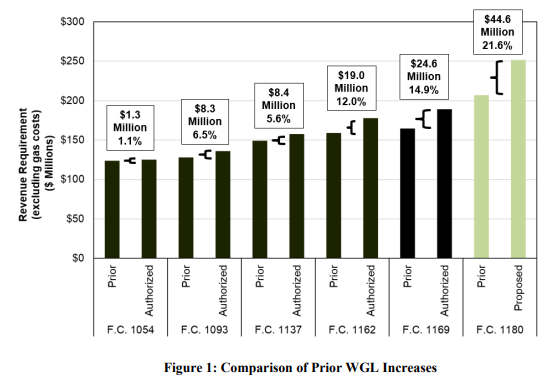
Source: https://ccanactionfund.org/media/source-comparison-of-rate-cases.pdf

End of 2025 Update

Results are in… and higher gas bills are on their way. With one in seven D.C. gas users already behind on their bills, on November 19th the D.C. Public Service Commission (PSC) voted 2-1 in favor of Washington Gas’s 13% gas rate hike that will further raise consumer energy costs ahead of the brutal winter season. The average gas bill will rise by double digits starting January 1, with half of the cost driven by Project Pipes. Read our day-of news alert here, and check out our explainer video on Instagram


Bottom line? Over just the last two years Washington Gas’s “rate base” (the supposed value of their system” has grown nearly 70%. That’s nearly unheard of, and it means higher bills for all of us. On top of that, the Commission failed to get to the bottom of Washington Gas’s use of ratepayer money for lobbying or sort out the entangled mess that is Washington Gas’s affiliate transactions. Basically, we don’t know what exactly we’re paying for… but we do know we’ll be paying more than ever before. Read Commissioner Beverly’s dissent (pg. 245) for the nitty-gritty details. 

What’s next? 

This docket is closing, and our gas bills will go up in January. And we can expect Washington Gas to submit another request for yet another rate increase later in 2026…

  • The PSC convened an evidentiary hearing in August 2025 to get answers on key outstanding questions in this docket, including more information on Washington Gas’s lobbying expenses. Sierra Club has been pushing for more complete information from the company for months. DC residents protested at the hearing, demanding the Commission reject the proposed rate hike.
  • Washington Gas revealed in July 2025 they included just over $14,000 of litigation expenses and almost $220,000 of costs associated with “government affairs labor costs” in their costs used to justify the proposed rate increase. We need a lot more details to truly understand what this money is being used for, but we know Washington Gas is suing the District for our building efficiency standards and lobbying at the Wilson Building against legislation to promote clean energy.
    In May 2025, Washington Gas filed the
    final rejoinder testimony, and intervenors all filed lists of material issues of fact.
  • In April 2025, nearly 70 D.C. residents testified at community hearings against the rate hike.
  • In January 2025, four intervenors filed direct testimony on Washington Gas’s proposed rate hike, and all has significant objections to Washington Gas’s proposal. 
  • In August 2024, Washington Gas filed an application for a rate hike. This application comes just seven months after the company’s last rate hike went into effect. 

Docket 1167: Gas Planning

Docket 1167 has long been the home of Washington Gas’s and Pepco’s “climate business plans,” long term “plans” that lay out unfulfilled suggestions for programs that could address the utilities’ climate impact. Historically, the Commission has failed to require them to be implemented, even partially, by the utilities. 

In response to repeated demands from residents, intervenors, and even the DC Council, the PSC is expanding the scope of the “climate business plans” docket to help envision real climate solutions regarding the future of gas in DC. The PSC has requested stakeholder comments from interested organizations and experts on the feasibility of establishing a gas planning proceeding in the District. 

End of 2025 Update

Pepco filed their 15-year Climate Solutions Plan at the end of October. Like the plans before it, this one is filled with a laundry list of ideas to electrify the District and put new electric grid capacity under Pepco’s ownership. 

What’s next? 

Advocates have long been asking for the Commission to take a more active role in directing planning processes, rather than starting with each utility company’s wish list. But we’re still waiting on movement from the Commission.

  • In July 2025, parties responded to the Commission’s request  for comments on how our utilities should track and report greenhouse gas emissions. Predictably, the utility companies largely recommended continuing to use existing reporting and plans, while the other intervenors urged the Commission to require more detailed reporting on emissions. Read the full comments from Pepco, Washington Gas, the Office of the People’s Counsel, Sierra Club, and DC government.
  • In June 2025, stakeholders filed reply comments to the initial round of comments on if and how the Commission should pursue gas planning, including environmental groups and Washington Gas. D.C. government also filed a whitepaper on how to effectively address gas leaks in the District. The report shows that the percent of D.C. residences using gas in our homes is falling, pipeline repair is consistently more effective at reducing gas leaks than advanced pipeline replacement to address aging pipes, and it would lower bills compared to Project Pipes.
  • In April 2025, stakeholders filed initial comments on the feasibility of gas planning, highlighting the need for both short term immediate action and long term planning for the future of thermal energy in the District. Read comments from CCAN and other environmental groups, D.C. government, and Washington Gas
  • In February 2025, the Commission extended the deadline for stakeholder comments on gas planning from February 10 to March 27. This also updates the reply comment deadline to May 12.
  • In December 2024, the Public Service Commission requested gas planning comments from stakeholders and another round of climate business plans from the utilities while planning processes are considered. Commissioner Beverly dissented, arguing “it makes no sense” to force Washington Gas to complete a plan without the benefit cost analysis due later this year, and disagrees with delays on the development of this BCA.

Docket 1182: Electric Planning

Docket 1182 was opened in November 2024 to collect comments on integrated distribution system planning (IDSP), which focuses on optimizing and modernizing the electric system to meet demands. Given DC’s climate commitments, advocates and officials hope this docket will lead to the development of a framework for Pepco’s planning that factors in the District’s increasing need for electricity due to the transition off of methane gas. 

End of 2025 Update

As usual, things are moving a bit slow at the Commission. The PSC issued an extension for convening the working group, which will now meet for the first time by February 2026. The group will work for six months on their report which will guide next steps.

What’s next? 

Stay tuned as the working group is established and gets to work in 2026!

  • In July 2025, the PSC decided to convene a working group to conduct integrated distribution system planning, after the urging of advocates since the spring.
  • In June 2025, Pepco  filed their long range plan, as directed by the Commission, outlining expected customer growth and planned capital expenditures.
  • In March and April 2025, experts submitted initial comments and reply comments outlining recommendations for a process to conduct integrated distribution system planning.
  • In December 2024, Commissioner Beverly published a letter with additional questions for stakeholders to answer, particularly about what data and information the Commission needs to collect from Pepco and how the process could ensure a transparent outcome.
  • In November 2024, the PSC asked interested stakeholders to submit comments on IDSP, including responding to a strawman proposal.

Stay tuned for more! If you have questions or want to get involved, email claire@chesapeakeclimate.org.