The recent op-ed, “Rising energy costs demand action in Maryland,” omits the most basic fact of energy today: The reliable energy source that is the most affordable and fastest to deploy is solar paired with batteries. Expensive fossil fuels are causing energy bills to increase, and affordable clean energy is the solution. For example, right now, Marylanders are paying $180 million a year to subsidize a coal plant because coal is so expensive they can’t operate without bailouts.
According to the U.S. Energy Information Administration, solar paired with batteries is cheaper than even a gas power plant. The total cost per megawatt hour of solar and batteries is $53.44, while the cost per megawatt hour of a gas plant is $64.55. Not only are they cheaper, but solar and battery power plants can be built much faster than a gas plant. If you ordered a turbine used in a gas power plant today, it would not even arrive for 4-6 years, whereas clean energy companies are shovel-ready today.
Texas has proved that it is possible to meet skyrocketing energy demand with clean, affordable energy. In Texas, where energy demand is growing faster than anywhere else in the world, the chance of a blackout decreased from 16% in summer 2024 to less than 1% in summer 2025 because in that time, Texas deployed 9,000 megawatts of solar and batteries. In the same time period, Texas saw a net decrease in natural gas capacity.
The only serious way to meet rising energy demand and lower the cost of electricity quickly is to build a lot of solar and batteries. That’s why we should all thank Chairman Brian Feldman and Chairman C.T. Wilson for passing the Renewable Energy Certainty Act in the Maryland General Assembly, which will help solar be built faster. On top of that, Senate President Bill Ferguson and former House Speaker Adrienne Jones should be applauded for passing legislation that will build 1,600 megawatts of battery storage. The great Del. Lorig Charkoudian and Sen. Benjamin Brooks are also introducing a terrific piece of legislation that will help even more solar get built in Maryland, lowering all of our energy bills.
Maryland families recently received letters and emails from their retail energy supplier informing them that their contracts were ending because of a new law called SB1.
What Marylanders should know is that retail energy suppliers are 100% able to offer consumers competitive rates under SB1, Maryland’s retail market was not closed down. Given a decade of terrible consumer pricing results, Maryland was forced to step in and add consumer protections. The issue suppliers have today is that their business models depended on charging exorbitant rates to most of their clients, while providing discounts to a few.
The good news is that Marylanders have options to save, and even go “green.” Plus, catch up on the real SB1 backstory to understand what’s happening in Maryland’s retail energy market.
Here are two effective ways to choose clean energy for your home after 1/1/25:
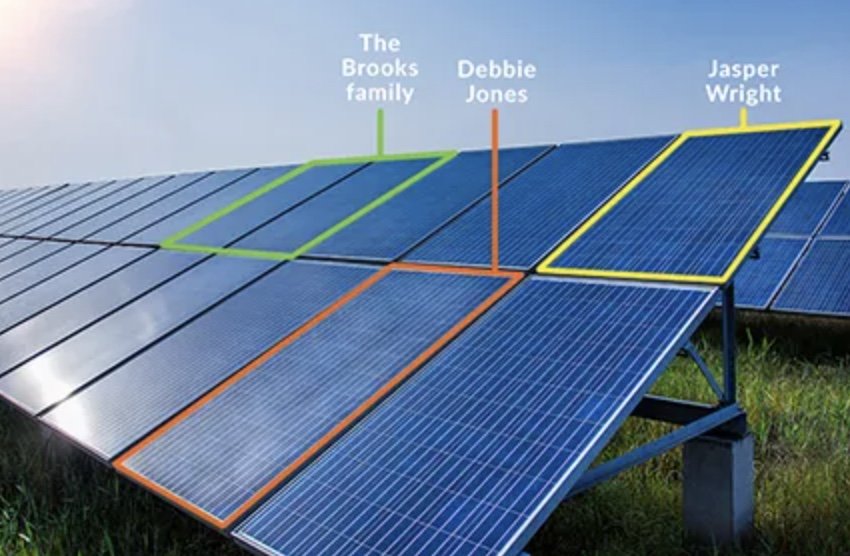
1. Visit this Community Solar shopping link to find an open local solar farm in your utility area. Subscribing to a local Community Solar farm means you are supporting new, local, solar energy that’s fed into your utility’s local grid. More clean energy means less carbon-based electricity. Better yet, Community Solar has always offered a discount that beats retail suppliers’ supply rates because Community Solar’s discount applies to both delivery and supply charges. In 2026, Community Solar will offer a one-bill option as charges and credits will be included on Maryland regulated utility bills, similar to today’s retail supplier charges.
2. Want to mirror your retail supplier’s green energy offer? Buy Renewable Energy Certificates (RECs) directly for $10 per REC from Terrapass. One REC equals 1,000 kWh, about the average number of kWh your home uses each month.
Retail suppliers did not purchase wind or solar electricity from wind and solar farms. They bought digital “green” certificates on behalf of their clients.
Here’s how retail energy “green” energy works:
Maryland residences are connected to a vast electricity grid called the PJM. Retail suppliers made their “green electricity” offers by pairing unbundled RECs with our local PJM grid electricity. The same grid electricity that your neighbor gets who didn’t switch to a supplier.
Retail suppliers report their electricity stats to the federal government in EIA861.
The average Maryland residence uses about 10,000 kilowatt hours (kWh) per year. The average retail supplier, like CleanChoice, Inspire Energy, Green Mountain Energy or WGL, bought about 7 unbundled RECs per account each year to make their “green” electricity claims. Buying from Terrapass will cost about $70 per year whereas retail suppliers charged between $550 to $950 more.
At $10 per REC, you’ll be ahead financially because Marylanders paid hefty premiums to buy retail supplier “green energy.” As an example, in 2023, CleanChoice customers on average paid about $108 per REC purchased on their behalf. Tomorrow Energy customers paid $160 per REC purchased for them.
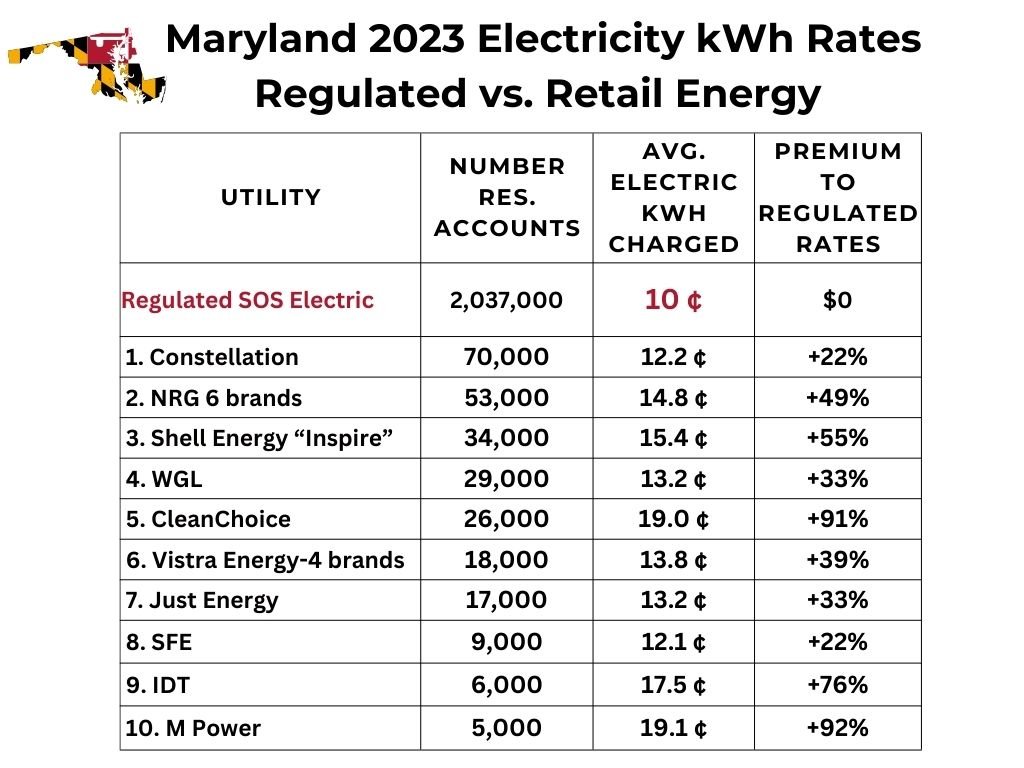
Curious how high were retail energy rates? Check out the chart comparing Maryland’s Top 10 retail suppliers average supply kWh rate to the average regulated utility supply 10¢ kWh rate. I also produced this YouTube explaining how voluntary digital RECs turned into 100% renewable electricity.
Why SB1 was Needed
Maryland opened its residential energy supply markets to competition in 1999. It wasn’t until 2010 when the Public Service Commission approved a sweet regulation, called purchase of receivables, that retail suppliers flooded Maryland’s consumer market to compete with BGE, Pepco, SMECO, Potomac Edison and Delmarva regulated utility supply offers.
Yet four short years later, during the 2014 winter Polar Vortex, the residential energy market began to sour. Instead of competitive energy’s promised “savings and innovation,” retail energy suppliers were charging sky-high variable rates that changed each month. During the 2014 Polar Vortex, retail supplier rates doubled, some even quadrupled. Complaints flooded into the PSC, yet Maryland supported retail energy for another decade.
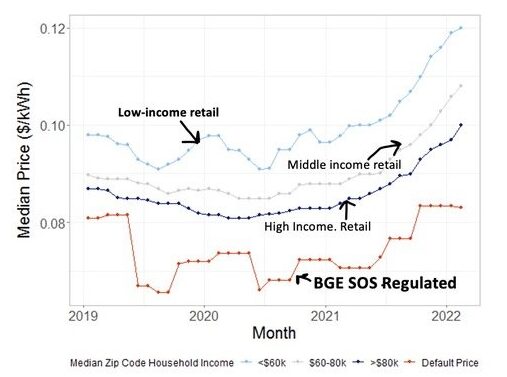
Jenya Kahn-Lang, a Berkeley Hass PhD student, produced an in-depth report using BGE retail choice data. She found that overall, no segment was saving, and that low-income accounts paid the highest premiums compared to regulated electricity rates. The prevalence of a majority black demographic in a ZIP code explained 45% of the pricing discrimination. Maryland opened its residential energy markets to competition, striving to help Marylanders, not to open the market for financial harm.
While a few retail energy customers figured out how to play the “promo” rate game and hop from teaser rate to teaser rate, by 2022, 400,000 families paid hundreds more each year, sometimes thousands more, than if they had stuck with regulated electricity and gas rates.
From 2014 to 2023, Maryland families paid $1.5 billion more than regulated energy rates.
Worse, mountains of data revealed predatory door sales in black and brown communities, intentional pricing discrimination with low-income accounts paying significantly more, thousands of PSC complaints citing aggressive sales people, and fraudulent sales.
SB1 was passed into law May 2024. The law requires suppliers to:
Meet or beat regulated rates.
Disclose what types of RECs support their green energy claims.
Have the PSC approve green energy offers.
Eliminate purchase of receivables regulation (suppliers are now responsible for their bad debt, not regulated utility rate payers).
Gives regulators more tools for reporting, regulating, and enforcing rules.
This website has loads of data, articles, and real bill samples detailing Maryland’s predatory retail energy market.
About the author: Laurel Peltier is a marketer with strong writing and storytelling skills and solid data analysis skills. Laurel recently finished a project managing the effort to reform Maryland’s energy supplier marketplace in the state’s General Assembly. In 2018, she co-wrote the Abell Foundation Report: Maryland’s Dysfunctional Energy Supplier Market.