Everyone has a few quirks. A big one of mine is to travel each year to a place I’ve never been and do a 100-mile bike ride. Since 1996, I’ve travelled across the US to a new spot each year to do a bicycle “century” ride. At first, I did them for the adventure and to stay in shape. But they morphed into something bigger along the way and became pieces of a puzzle showing how geology and climate change have impacted our country. I rode the “Hotter Than Hell 100” in Wichita Falls, TX in 2013, which lived up to its name with an air temperature of 102 degrees. The natural waterfall that gave the town its name was no longer- having been taken out by a flood in the 1800’s. In 2015, the “Cycle Greater Yellowstone” ride passed trilobite fossils embedded in Wyoming cliffs from the Eocene epoch (34 to 56 million years ago) when a vast, shallow sea covered the state. This year, I went to the heart of Cajun country in Louisiana for a Bayou Century Ride.
Central Louisiana prospered in the 1700’s when French Canadians (known as Acadians) were lured to the area from Nova Scotia with the promise of a better future. The Acadians created the Cajun culture by combining their French traditions with their new bayou homes. They hunted, fished, trapped and raised cotton. Cotton was replaced by rice and sugarcane fields after the Civil War and through the 1800’s. Next up was the oil industry, which drilled its first well in a rice field near Jennings, LA in 1901. Today, over 205,000 oil wells exist in the state. Climate concerns and the need for a cleaner environment are making oil a tenuous business, and Louisiana suffers some of the harshest climate impacts of any state. Louisiana’s Gulf Coast region accounts for nearly half of the US mainland’s coastal wetlands. Yet since the early 20th century, the commercial ventures of oil exploration and logging, along with hurricane damage, have led to the destruction of almost 2,000 square miles of wetlands. Louisiana has been hit with 28 hurricanes since the year 2000. The strongest was Hurricane Katrina in 2005, causing over 1,800 deaths and $100 billion in damages. The second-strongest, Hurricane Ida, occurred on August 29, 2021 (ironically, the 16th anniversary of Katrina), rendering the entire state a FEMA “Disaster” area.
According to a 2020 ProPublica study, an estimated 4 million US residents will become “climate refugees” between 2040-2060. They will move to the north and midwest as the southern and coastal regions of the US become too difficult to live in. When we hear the term “climate refugees” we tend to think of people in countries thousands of miles away. We think of heat waves in India causing residents to move to cooler locations or of sea level rise in Indonesia that is forcing the entire city of Jakarta to move to higher ground in Borneo. In reality, climate refugees are all around us and their numbers are on the rise. As the ProPublica study shows, the need for habitable land, freshwater and safety will be driving millions of Americans to flee sea level rise, wildfires, extreme heat and drought in the coming decades. No federal agency has authority to lead national assistance on climate migration efforts. This is a problem that needs to be solved- quickly.
St. Martin Parish, Louisiana is ranked number 3 on the “most at-risk counties” due to climate change (behind Beaufort County, SC and Pinal County, AZ). My Bayou Bike Ride was centered in St. Martin Parish, starting in the town of Breaux Bridge, Louisiana. The self-proclaimed “Crawfish Capital of the World”, Breaux Bridge could have been the original movie set for “A River Runs Through It”, as the Mississippi River cascaded directly through the area 5,500 years ago. Like any river, the Mississippi is always in search of the path of least resistance, and it shifted eastward over millennia, carving out new channels as it went.
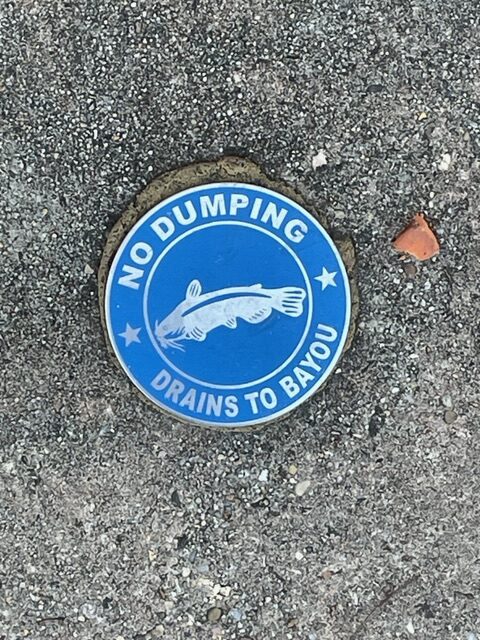
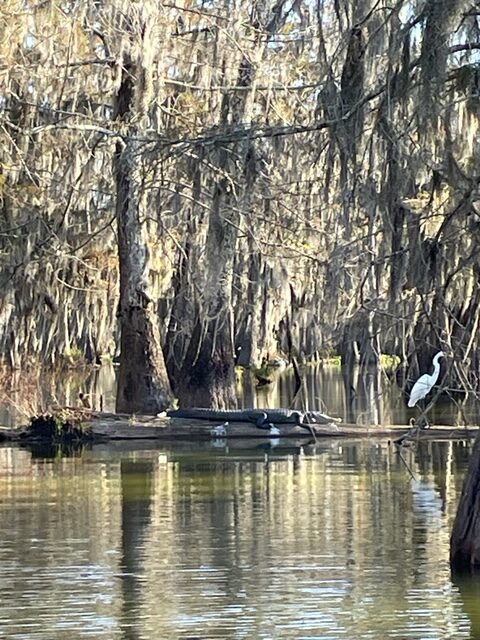
Ever-changing outlets and inlets formed Louisiana’s bayous. A bayou is technically a slow-moving stream. It differs from a “swamp” because swamps are stagnant water bodies with no flow-through, although their waters may rise and fall seasonally. Louisiana’s coastal bayous contain a mixture of saltwater and freshwater, known as brackish water. Vast cypress forests thrive here, as do alligators and over 200 species of birds. The shifting path of the Mississippi created healthy swamps and bayous, but caused irreparable damage to communities displaced by the whims of the River. In Breaux Bridge, it left behind a channel that now holds Bayou Teche. The town of Breaux Bridge was inundated with 25’ of water in 1929 when the Mississippi River flooded. To prevent this from happening again, the US Army Corps of Engineering developed the Atchafalaya Basin Project, a series of levees and locks that contain an 833,000-acre floodway to catch Mississippi River floodwaters. Breaux Bridge is protected by a levee to the east of the town, a 30-foot tall earthen mound that runs for many miles and has become the social scene. Airboat swamp tours and restaurants dot both sides of the levee, with bayous on one side and the floodway and swamps on the other. I booked an Atchafalaya Basin Airboat Swamp Tour, joining a group of 7 others as we glided through 500-year old cypress trees. The swamp was alive with wildlife, and we watched herons, egrets, owls, nutria, and a dozen or so alligators go about their day.
Photos by Janet Redman
My Bayou Bike Ride took place on November 6, 2021, while much of the state was still recovering from Ida. The scheduled “sunrise” start of 7:33A was delayed for 30 minutes by a heavy fog. About 125 riders took off, covering anywhere from 15-100 miles on a variety of routes. The 100- mile route followed Bayou Teche north from Breaux Bridge, looped through St. Landry Parish and returned south on the levee. Along the way, four rest stops refueled riders with Gatorade (naturally), bananas and gouda-and-pimento sandwiches. The ride began and ended at Tante Marie, a Cajun restaurant that welcomed riders home with gumbo, jambalaya and local beer from Bayou Teche Brewery. Although the route was fairly flat, it was challenging due to the wind and the need to pedal constantly.
I spoke to Glenn Monte, a volunteer on the century ride and the owner of a construction business that builds metal houses, primarily in St. Martin Parish. He has more business than he can handle right now, thanks to Hurricane Ida, and estimated that his company was building 18-20 homes in the town of Houma alone. His metal homes can withstand winds of up to 200 mph, an appealing trait in a battered state. I asked him about the resilience of the communities. How many times can someone rebuild, after all? He replied that the area “is simply home” to many people, and moving elsewhere is a hard concept to grasp. Having lived in LA for 55 years himself, Glenn has seen coastal degradation of his favorite hunting and fishing spots. The environmental crisis spawned a new word in the early 2000’s. “Solastalgia” is a term formed by the combination of the Latin words sōlācium (comfort) and the Greek root -algia (pain, suffering, grief). It describes a form of emotional or existential distress caused by environmental change, such as living through a storm that devastates one’s home or community. The feeling of safety that someone once had in that home is gone forever.
One of the first examples of “climate refugees” in the US is found in Louisiana, where a relocation program is underway. Isle de Jean Charles is a narrow island in Terrebonne Parish that is home to indigenous tribes (the Bilox, Chitimacha and Choctaw). The island once encompassed 22,000 acres, but erosion and subsidence have slashed that to just 320 acres. The road to the mainland- Island Road, built in 1953- is often impassable due to storm surge, sea level rise, tides and high winds.
In 2016, Louisiana was given a $48.3 million dollar Community Development Block Grant to work with Isle de Jean Charles residents to retreat and resettle into a safer community about 40 miles north. Plans call for all homes to be built 3 feet above the 500-year flood plain and the first residents are scheduled to move in by the end of 2021.
Closer to home, Tangier Island, a small Virginia fishing town that 400 people call home, is sinking quickly and predicted to be uninhabitable wetlands by 2051. To relocate the townspeople to the mainland is pegged at $150 million; to bulk up the island and protect its shoreline would cost $350 million. It is a victim of both sea level rise and ground subsidence and over 67% of its land mass has disappeared since 1850.
My bike rides have revealed climate secrets over the years, showing how wind has carved mesas and buttes in Albuquerque, New Mexico and flowing water has created canyons in Moab, Utah. In Louisiana, I learned that the dual destructive forces of climate change and humans are strong enough to drive long-standing communities to safer ground. And I don’t see a finish line in sight.
REFERENCES
Federal Emergency Management Agency (FEMA). (October 19, 2021). Areas of assistance, FEMA map. dec_4611.pdf (fema.gov).
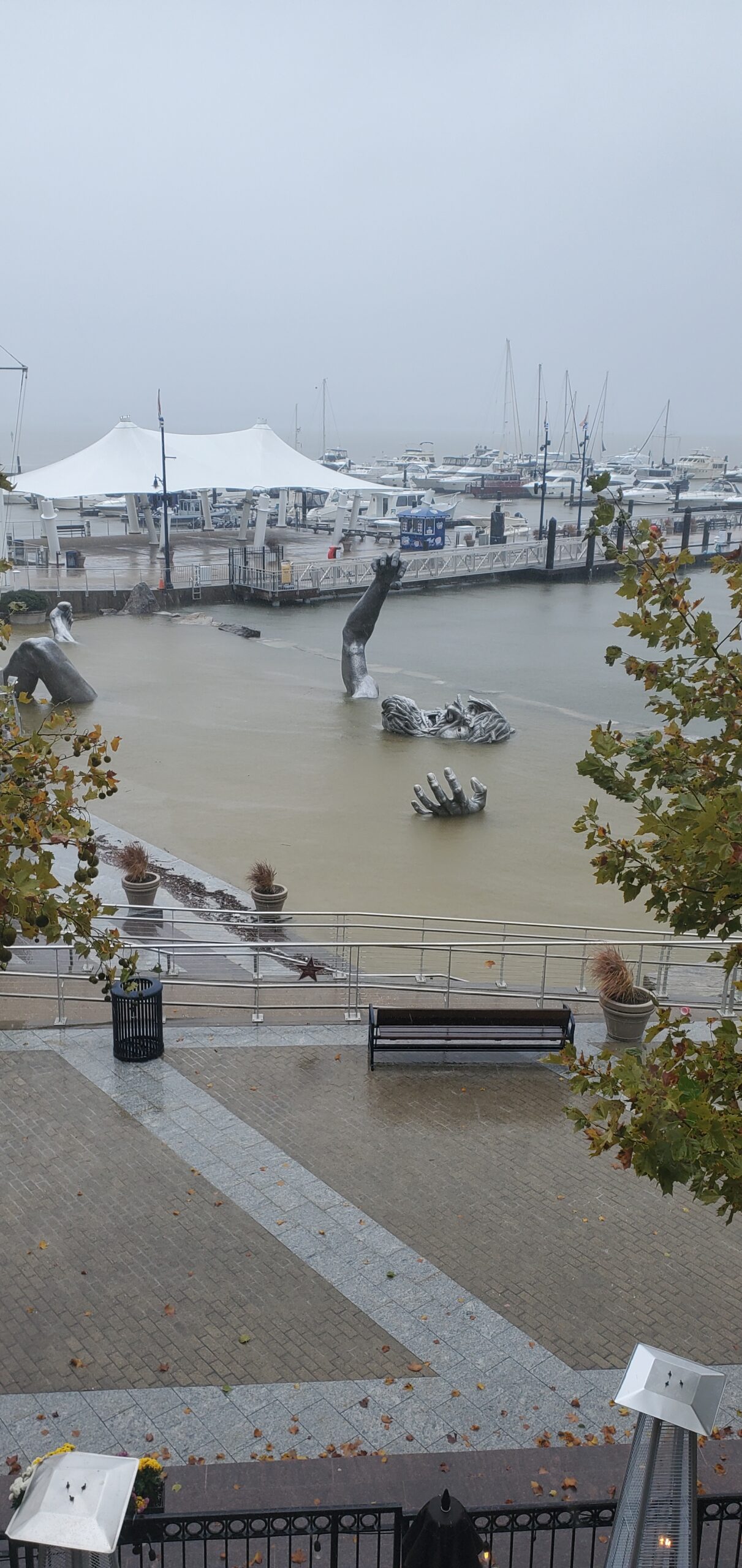
Photos of “The Awakening” in National Harbor, Maryland, during Halloween weekend, 2021. Photos courtesy of Dean Najouks, Potomac Riverkeeper Network.
Halloween weekend always produces some startling sights, but in 2021, the most frightening image of all wasn’t a ghoul or ghost, but a very real picture of an iconic statue slipping below climate change-driven flooding.
“The Awakening” is an aluminum statue located in National Harbor, MD, just a few feet away from the tidal Potomac River. The statue was originally created in 1980 by the late Seward Johnson and located on Hains Point in Washington, D.C. before being moved to its current location in 2008.
In normal conditions, the statue depicts a giant grasping at the air, struggling to emerge from the earth. However, after the Mid-Atlantic experienced some of the region’s worst tidal flooding in years this weekend, the sandy space where the statue sits was inundated with unusually high floodwaters. Instead of emerging from the dry ground as the artist intended, the giant appeared to be drowning as water filled its open mouth and rose several feet to nearly eclipse one of its massive hands.
What The Awakening statue in Maryland looks like normally, and what it looks like today pic.twitter.com/UdS3JsCBYP
Unfortunately, this image is one that we will see with increasing frequency as climate change causes more precipitation and severe storms along the East Coast, including in D.C., Maryland and Virginia. According to a 2018 NOAA report, the average incidence of high-tide flooding in the Mid-Atlantic doubled between 2000 and 2015, from three to six days a year. National Harbor wasn’t the only local area affected by the flooding over the weekend—the mayor of Annapolis paddled through his city’s streets to assess flood damage, waves lapped at storefronts in Alexandria’s Old Town, and the Tidal Basin overflowed in downtown D.C. In Annapolis, early data shows this weekend’s flood was the fourth-highest in the city’s recorded history.
What is especially concerning about this weekend’s flooding is, as anyone who was in the area can attest, there wasn’t a deluge of rainfall that caused the Potomac River to flood D.C. and surrounding areas. Instead, as Dean Najouks of the Potomac Riverkeeper Network pointed out, distant storms drove water up the river from the Atlantic, meaning the flooding was the “direct result” of sea-level rise and climate change. Although hurricanes and large rainstorms will also pose increasingly dire threats, it’s clear that it doesn’t take a direct hit from a storm anymore to cause significant flood damage in the region.
Although the viral photos of “The Awakening” this weekend provide a dramatic snapshot of the effects of climate change, the more haunting fact is that these impacts are constantly occurring whether we get a striking picture of them or not. To preserve our region’s health, safety, economic-well being and overall quality of life, it is imperative that we take steps now to immediately reduce our climate-disrupting emissions.
VA Department of Environmental Quality Finalizes C4GT Gas Power Plant Cancellation
Activists celebrate after leading a years-long campaign to stop C4GT, turn efforts to other dangerous fossil-fuel projects moving forward
Charles City, VA — After years of activists campaigning to stop the C4GT Gas Power Plant, the developing company, NOVI Energy, announced its move to cancel the proposed project a month ago. Finally, this past weekend the Virginia Department of Environmental Quality (DEQ) made the cancellation official when the DEQ Deputy Regional Director signed the mutual determination letter that officially shuts down the project.
Sited next to an environmental justice community, less than a mile from a second proposed fracked gas power plant, the C4GT proposal faced enormous community opposition from the outset. The directly impacted group of residents leading the fight against the project, Concerned Citizens of Charles City County (C5), joined the Stop the Abuse of Virginian Energy (SAVE) coalition to protest the project, and build grassroots opposition to the proposal. Primary concerns included the lack of any meaningful public engagement in the process, and the DEQ’s green-lighting the project despite the developers’ failure to construct at the site within their legal window.
Ultimately, a FOIA request by SAVE Coalition member Food & Water Watch found that the DEQ had the legal ability to cancel C4GT’s air permits and cancel the project — indeed they had already drafted a letter revoking the permits. A few weeks later, the company behind the project withdrew.
Now that the C4GT project is officially terminated, activists turn their attention to the similarly dangerous Chickahominy Power Station and Chickahominy Pipeline proposals, still moving forward in Charles City County.
“Our community won when the developer was unable to continue with the destructive proposed C4GT power plant,” said Wanda Roberts, an impacted resident and member of Concerned Citizens of Charles City County. “We will continue to fight to stop the Chickahominy Power Plant and pipeline. There is no need or necessity for gas power plants to be built in Virginia.”
“The termination of the C4GT fracked gas project is a victory for grassroots climate organizing in Virginia,” said Jolene Mafnas, Virginia Organizer with Food & Water Watch. “Virginians statewide are rising up against the fracked gas and pipelines that endlessly crop up in our backyards. The age of fracked gas is over in Virginia — it’s time to double down on true clean, renewable energy and stop the buildout of fossil fuel infrastructure. Governor Northam must direct his agencies to terminate the Chickahominy power plant and pipeline, just like C4GT.”
“The cancellation of the C4GT power plant is yet another sign that Virginia is leaving behind costly and hazardous fracked gas infrastructure,” said Lauren Landis, Chesapeake Climate Action Network’s Hampton Roads Coordinate, “The argument for similar projects is untenable and community organizers will not stop until they all reach the same fate as C4GT.
“Another hard won victory for the Charles City County Community, the state and the nation in keeping dangerous fossil fuel operations from contributing to climate change and ultimately destroying our lives,” said Lynn Godfrey, Sierra Club’s Community Outreach Coordinator. “Salute to the grassroots efforts of the community organizers in Charles City!”
“Environmental justice begins and ends with communities. The cancellation of the C4GT power plant is a testament to the dedication of the Concerned Citizens of Charles City County and all the grassroots advocates who have supported them in this fight,” said Taylor Lilley, Chesapeake Bay Foundation Environmental Justice Staff Attorney. “CBF is honored to work with the people of Charles City in opposing projects that threaten the environment and public health.”
It’s hot. Really hot. But instead of listing the new nightmarish impacts and scenarios, I’d like to share some hope and updates on the solutions our team has been fighting for over the past few months.
How clean energy policy is bringing steel back to Baltimore
by victoria venable
Baltimore was built on steel, and Baltimore was devastated by steel. But now, thanks to Maryland’s strong clean energy policies, Baltimore has the opportunity to become a steel hub once more — and a lynchpin for a healthy, sustainable economy.
At one point, Sparrows Point on the Port of Baltimore was home to the world’s largest steel mill. The mill brought tens of thousands of jobs to the area and helped shape the city. Steelworkers still call it “hallowed ground” for steel. But history was not enough to protect Baltimore from the steel industry’s decline — far from it, Baltimore faced particular economic devastation partly due to the steel industry’s demise.
That’s why this month’s announcement of a new steel mill in Baltimore County feels particularly huge. US Wind announced a new offshore wind project called Momentum Wind, major labor agreements with the Baltimore-D.C. Building & Construction trades union and the International Brotherhood of Electrical Workers to provide union labor to support US Wind’s first major offshore wind project for Maryland, a $77 million investment in a new 90-acre port facility to service offshore wind development in Maryland, and a proposal for a new steel fabrication facility in Baltimore County at the Tradepoint Atlantic site, now called Sparrows Point Steel.
These projects will create hundreds of union jobs building offshore wind turbines right here in Maryland, to bring offshore wind to the electric grid in Maryland, helping ease us off the dirty energy sources that have polluted areas like Baltimore for so long.
I feel a particular attachment to this news because I know firsthand how it’s the result of grassroots advocacy and legislative achievements.
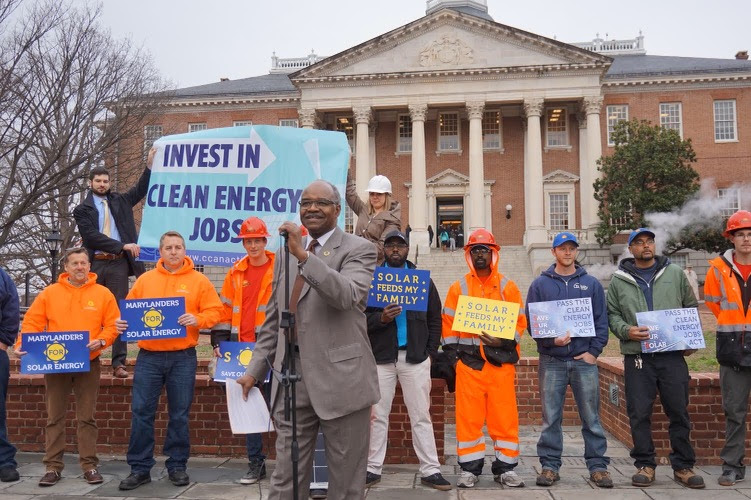
Delegate Brooks at a rally supporting the Clean Energy Jobs Act
While I was studying Political Science and Economics at Washington College, I watched the movement of the Maryland Offshore Wind Energy Act closely — and its passage inspired me to work in state energy politics. Shortly after graduating, I took my first full-time position with Del. Ben Brooks, a key player in public utilities, where I worked with him to pass the historic Clean Energy Jobs Act. Now, five years later, as the new Maryland Director of Chesapeake Climate Action Network, I’ve had an eye on new renewable energy deployment all summer, waiting for the US Wind announcement.
Reading over the details of this momentous step forward for offshore wind in Maryland – 82 additional turbines, 3500 new construction jobs, more than 500 local, permanent jobs, a new steel fabrication facility in Baltimore County – I couldn’t help but think back to the hundreds of meetings I’d sat in on with Delegate Brooks and various stakeholders in the fight for increased clean energy projects between 2016 and 2019.
During the time I worked for Delegate Ben Brooks, who represents parts of Baltimore County, between 2016 and 2019, he not only sat on the Economic Matters Committee but also served as the Public Utilities Subcommittee Chair. Some of my first meetings on his staff were with folks from US Wind and Ørsted, hearing promises that expanding Maryland’s Renewable Energy Portfolio Standard (RPS) and adding 1,200 MW of offshore wind would bring jobs and economic growth to Maryland by making it a leader in the offshore wind industry. It was the focus on manufacturing jobs, union involvement, and bringing the supply chain for OSW to Maryland that stuck with me as I continued to work on this legislation with Delegate Brooks. Where so many could see challenges in the energy transition, we couldn’t help but see great opportunity, and maybe even redemption.
While much of the Clean Energy Jobs Act focused on the energy transition as a way to mitigate climate change, Delegate Brooks and I were excited to work with the renewable energy industry to address another change we saw in his district, in Baltimore, and throughout Maryland: the loss of manufacturing and unionized jobs.
Now, true to its name, the Clean Energy Jobs Act is creating good-paying and unionized clean energy jobs by bringing steel back to Baltimore with Momentum Wind and Sparrows Point Steel. Only two weeks into my new role as the Maryland Director at Chesapeake Climate Action Network and my work has come full circle to where I started as a staffer for Del. Ben Brooks in Annapolis. Seeing clean energy policy bring projects like this to fruition is the poetic capstone of one stage of my career and the exciting commencement of this next phase.
With the legislative session around the corner, federal funding on its way, and the midterm elections next year, it’s time to ride the momentum of this great example of just transition and job creation to continue our work to decarbonize Maryland’s energy sector and reduce emissions across the economy. I’m excited to be back in Annapolis this January, this time representing CCAN and our coalition of climate-focused Marylanders. With the consequences of climate change more pronounced than ever, we will need bold policy and a mobilized base – I hope you will join me!
Last week labor leaders joined climate advocates in what would normally be considered an unlikely cross-over episode. They rallied on the National Mall, in Washington, D.C. to show congress their support for an immediate passage of President Biden’s “American Jobs Plan” with a 100% Clean Energy Standard.
Read the full transcript below.
Charles Olsen 0:01
Hi, my name is Charlie Olson, and this is Upside Down the podcast from the Chesapeake Climate Action Network. Last week, climate advocates and labor leaders from around the DC area joined together on the National Mall to show their support for President Biden’s American jobs plan and the 100% clean electricity standard. The audio of this episode is taken from that rally. Enjoy.
Unknown Speaker 0:33
So here’s our message to Congress. Y’all got a lot of work to do over there. The bipartisan senate infrastructure bill last week does not come close to taking care of workers and the climate doesn’t come close. The roughly $600 billion in new spending is a start. But it leaves out nearly three quarters of President Biden’s vision under the American jobs plan released in March includes among other features $400 billion in investments for wind and solar construction of 500,000 electric vehicle charging stations and weatherization of 2 million low income homes. The plan also explicitly calls for passage of the protection of the right to organize act a bill that our labor colleagues have prized for decades. So I’ll let my friends in labor and from the hill explain more. But Congress, you must do more. Every feature dropped by the slim down insufficient senate infrastructure deal must be restored through additional bipartisan votes or more likely through budget reconciliation, all $2.3 trillion. All $2.3 trillion of Biden’s original jobs plan must become law, not $1 last for workers and clean energy. Now on to our first speaker. Now when Joe Biden first unveiled the American jobs plan in Pittsburgh and march It was a union worker who introduced him with the International Brotherhood of Electrical Workers. So we are thrilled to kick off this rally with Tom Clark, a 30 year member of the IBEW Local 26, here in the metro area region and a member of their executive board Tom.
Unknown Speaker 2:32
Good afternoon. As a proud member of the International Brotherhood of Electrical Workers, I anxious anxiously await the passage of the American jobs plan. This forward thinking piece of legislation puts America to work in 2021, but its effects will last well into the 22nd century. With the promise of installing 500 electrical vehicle chargers across the nation, President Biden has tat the IBEW to lead this clean energy project. Our president knows that the International Brotherhood of Electrical Workers are right now training young men and women for the green energy jobs at a future at no cost to the state. President Biden knows that union electricians collectively bargain for health care, annuities and defined pensions at no cost to the state. The White House knows that these very benefits will not only lead to a thriving middle class for my fellow electricians, but ensure future generations the same opportunities for success. The American jobs plan is not only multi generational, but addresses the gender pay gap as well. Because when union jobs, men and women get paid the same period. I’d like to thank President Biden and all congressional leaders for getting the American Job plan to this point. The future this bill is now in our hands. It’s now time for the American people to get to work. I asked all citizens to notify their representatives about the importance of passing the American Jobs Act. I ask all elected officials on Capitol Hill to get to work, compromise and pass all aspects of this vital jobs bill. This once in a lifetime bill that promotes clean energy and the American worker. Finally, I asked my fellow blue collar members to in organized labor, let’s strap on our tools and get to work. Thank you.
Unknown Speaker 4:51
Thank you, Tom Clark with IBEW Local 26. Now, you know after the disappointing and pared down Senate Structure agreement last week, there’s been a slogan that’s been circulating among climate advocates and congressional leaders. That phrase is no climate. No Deal. But I picked that phrase as incomplete. I think it should say, no unions, no deal as well. So I’m gonna speak here. And when I, when I yell something out, I want you all to respond with no deal. Okay, are you ready? No climate. No unions. No climate. No unions. No climate. No unions. Okay, y’all, they can’t hear you at the Capitol. All right. So we’re gonna do that one more time. You’re ready. No climate. No unions. No climate. No union. Fantastic. Thank you so much. Our next speaker is David Steven. He’s the political and legislative director of the metro Washington Council of the AFL CIO, David
Unknown Speaker 6:08
Haye, thank you. It is beautiful to be out here. Amongst all of our labor folks. On this beautiful day, y’all Give yourselves a hand for coming out here. To help me out, show me what democracy looks like. Show me what democracy looks like. Show me what democracy looks like. All right. All right. Now, you know, it was Dr. Kane that said that justice, or excuse me, peace is not merely the absence of tension, but the presence of justice. And I want to take this opportunity to thank congressman Bobby Scott, Congressman john Yarmuth for coming out here and standing with us as we fight for economic justice with our union brothers and sisters, y’all give them a hand. Now, President Biden knows unions are key to rebuilding an economy that works for the rebuilding. That starts with the passage of the American jobs plan. The Washington, DC metro Labor Council, is urging Congress to listen to the 10s and 1000s of union members right here in the District of Columbia, who are sick of a system that benefits billionaires at the cost of workers, it is time for Congress to pass the American jobs plan. This package will not only make critical investments into our nation’s infrastructure, but will help build a growing clean energy economy that is powered by millions of good paying jobs. Now, show me what democracy looks like. Thank you, God bless you.
Unknown Speaker 8:06
Thank you so much. And I want to ask congressman Bobby Scott, to step forward, it’s your turn. And congressman Scott, representing the third congressional district has been in Congress since 1993, is chair of the education and Labor Committee, a great friend of labor. And I want to begin, Congressman Scott by handing you a letter that was signed last week by 1700. Union households, not just from this region, not just from Virginia. But this letter calls for passage of the American jobs plan. And a clean energy revolution in this country was signed by 1700. Union households in all 51 States of America. And all their names are right here. So I want to hand this to you in recognition of your work. Please tell your colleagues that labor is with you. The climate movement is with you. And we are with you.
Unknown Speaker 9:14
Thank you. Thank you. Good afternoon. Good afternoon. I am Bobby Scott representing Virginia’s third district and that’s where the James River, Nansemond river and Elizabeth River all meet the Chesapeake Bay. And I want to thank you all for what you do to try to clean up the Chesapeake Bay. I’ve been working on it since I was in the Virginia General Assembly. In 1978. I was on a Maryland, Virginia, bipartisan legislative committee to see what we could do. And the first thing we decided to do is that Maryland and Virginia wasn’t enough. We didn’t get everybody involved. We’re wasting our time. And that’s why the Chesapeake Bay commission was formed many years ago. And so we’ve been working on this a long time and we’re making some progress. But we’re gonna thank you for all that you do. Now I also chair the committee on education and labor where I’m proud to advance the interests of working men and women. And I’m also the proud sponsor of the project, which passed the House of Representatives and do what you can to get it out of the Senate. Now, as we gather today we’re suffering through in the Pacific Northwest, we’re suffering through a dangerous heatwave precedent setting they used to have I’ve heard 90 degrees used to be noteworthy. They’ve had several days in a row where it’s over 110. I heard that an ice cream parlor had to close because the air conditioning couldn’t keep the ice cream cold enough. I mean, you think an ice cream parlor would be making money hand over fist similar weather like this not able to close because they couldn’t deal with the weather you got people in Detroit suffering from from flooding and coastal communities, including those hit by hurricanes last year preparing for another hurricane season. All of this is happening because of climate change. And you know that there’s another direction we ought to be taking and workers are leading the way. I’m proud to be here with my colleague, the Budget Chairman, John Yarmuth of Kentucky and hopefully, Joe Morelli, from New York will be here in a few minutes. And we’re working hard to get the American jobs plan to the American families plan passed in the United States Congress. We recognize this as a once in a lifetime capital investment, just like it was once in a lifetime when Dwight Eisenhower right after world war two created the interstate highway system, we have the opportunity to have a once in a lifetime infrastructure plan that not only does roads and bridges, and tunnels, and ports, and schools, the CDC said functioning ventilation systems are an essential element opening school safely. So we need to make sure in Virginia, half the schools the more than 50 years old, we need to make sure that we have school reconstruction, housing advice has already been mentioned, and broadband to bring communities into the 21st century, we need to do they have charging stations, people are gonna buy electric cars that they can charge them on the highway, people aren’t going to build charging stations and people aren’t buying electric cars. So we start off with the electric charging stations, people buy more cars. And next thing you know, every restaurant on it near the interstates is gonna have a charging station, because they’re going to attract people to those they’re gonna hook up with and then they’re gonna go right in the restaurant and buy a meal. That’s how you do it. But you have to have somebody with the vision to do the dude to do it first. We also need to do what it takes to put people to work. That’s like daycare, childcare, and early childhood education. So people can go to work and job training. So they’re so they have the skills to perform the work. All of that can be done in a climate friendly manner if we do it right. And that’s why rallies like this are so important. Why I’m so happy to be here. And I look forward to working with each and every one of you as we do what’s necessary to pass not only the American jobs plan, but also the American families plan and do it in a critical climate friendly way. Thank you very much.
Unknown Speaker 13:33
Really appreciate it. Thank you. Thank you, Congressman Scott, and thank you for all your leadership and making time for us in this heatwave. I next want to bring up another committee chair. We are very, very fortunate to have congressman John Yarmuth. Again, he is also from the third district but this one in Kentucky. He is in his eighth term in Congress. He is chair of the House Budget Committee. It is through congressman Yarmuth that any kind of reconciliation bill is going to have to travel and so we are fortunate to count him as a friend and Congressman Yarmuth, I too want to hand you this letter from 1700 labor households in all 51 states. So that includes the district, and we appreciate all that you do.
Unknown Speaker 14:27
Well, good afternoon, everybody. It’s great to be here. Thanks for standing up for the future of our civilization. It’s a good thing to be for. It’s great to be here with my colleague, Bobby Scott. Bobby’s my chairman. I’m his chairman. And incidentally, Joe Morel is on both the budget and the education labor committees as well. So we’ve got a monopoly here on the program. You know, about two years ago, I made a speech to the Louisville reference Louisville, Kentucky, by the way, I gave a speech to the local Rotary Club. And I said, The theme of the speech was that we’re in this incredibly interesting and probably unique time in our history. And that is that art history is catching up with us, and the future is getting here faster than we thought. And one of those things that illustrates that is climate change, we have our neglect for the environment, over generations and generations has brought us to this point. And it’s climate change. The climate threat is reaching us faster than anybody anticipated. Another area that that? Well, there are a lot of things. But I said, there are three things we need to be doing right now, as intensively as possible, if we’re going to have a future for our country. And number one is to deal with climate change. Number two was to deal with early childhood education, because unless we make sure that every young person in this country has the strongest possible Foundation, there isn’t going to be much of an economy or future for anybody then. And when I look at the American jobs plan, and the American families plan, and then you add in the American rescue plan, there is one unmistakable theme. And that is, we are trying to build a future for our country, for our children and grandchildren. And, that future involves dealing with climate change, so that there is in fact, a future. And right now, as Bobby mentioned, we’re seeing the manifestations of climate change every day, everywhere in our country, everywhere around the world. And it’s time to act. And one of the things that I’m so excited about with American jobs playing in American families’ plans is that finally, after decades and decades, we have leaders in Washington, who are asking the important questions in the right order. Now, what do I mean by that? For decades and decades, whenever we identified a problem we thought we needed to deal with, what was the first thing we asked, what can we afford to do? That’s not the right question. That’s not the right question. The right question is, number one, what do we need to do to serve the American people? Not the people we’ve been serving, who are the ones in the top 1%, and so forth. That’s, that’s the other party that serves them. But President Biden has finally started asking those questions in the right order. What do we need to do to prepare our young people for their labs? What do we need to do to save the country? environmentally? What do we need to do to build a 21st century economy and not a 19th century economy? What do we need to do to build an economy that actually looks forward to the future as opposed to looking back to the wagon trail days, again, that other party does that. And when we passed the American rescue plan, with its emphasis on children, the expanded child tax credit, which is the checks are going to start going out in about two weeks, to give every parent the means to lift their children up. Half the kids living in poverty are going to be lifted out of poverty with this, to give it to Gibbs, yes.
Unknown Speaker 18:28
To give state and local governments and school systems the resources they need to do things in an environmentally friendly way. And so to retrofit schools to build new schools and buildings that are environmentally friendly, that conserve energy, and so forth, and giving cities and towns and counties and states the money to do that as well. But there’s a reason that this major proposal, the American jobs plan, is not called the American infrastructure plan. The Republicans want to have a debate over what’s infrastructure. They don’t think childcare is infrastructure, they don’t think care for the elderly is infrastructure. They don’t think of the electric grid electrification for electric vehicles, any of that stuff’s infrastructure. Okay, who cares? That’s not what the name of the bill is. The name of the bill is the American jobs plan. Because the idea is to create millions of jobs while we realize this, this future oriented economy that we’re trying to build. I was thrilled to have my name on the American rescue plan. That was the day we passed that I said to myself, I asked myself, have I ever had a better week in my life? And I said, not even close. To have my name associated with something that changed lives so dramatically and made the kind of investment in our people that we did was something that I will always cherish. I had that opportunity. And now I have the opportunity to do it again and again. And believe me, I’m gonna do everything I can to make sure that the American jobs plan on the American families plan. And then whatever we do next year, when we can do reconciliation again, and do something that serves the American people, I’m going to be right there as well. So thank you so much for your passion, your commitment, and, and your interest in making sure that our future is a bright one, an environmentally friendly one, and one, which serves all of the people in this country, and not just the very few. We’ve seen how that works, we’ve seen the trickle down theory, not so good. We’re gonna build the next economy from the ground up, and make sure that the 99% who have been figuring out how to get by, won’t have to worry about that. They’ll work and they’ll get by, and the jobs will be there, and the future will be there for them. So thanks for all your work. Thanks for having me here today and get on with the rest of them, because we’re gonna need some help. It’s not going to be easy. But I think everybody in the Democratic Caucus, we’re not expecting to get any Republican votes. But everybody, the democrat credit caucus, we may have different ideas. But we all know that what we’re trying to do is the right thing, and we’re all agreed on the objective. So we’ll get there. Thanks for your support. We need it.
Unknown Speaker 21:29
Thank you, Chairman Yarmouth and our next speaker is also a member of Congress. Congressman Joe Murali, a Democrat from New York, he’s on both the House Budget Committee and the house education Labor Committee, proudly serves New York’s 25th congressional district. He’s got some really important business to deal with back on Capitol Hill involving something like armed services or something like that. So we wanted to bring him on up to the stage, I present to you Congressman Joe Murali.
Unknown Speaker 22:05
Good day.
Unknown Speaker 22:07
Good afternoon, I think it is a good afternoon. It is. Good afternoon, everyone. And thanks for being here. It’s wonderful to see you here at the nation’s capitol. I am honored to be talking alongside two of my favorite members of the House and to Chairman on whose committees I serve Bobby Scott, chairman of the education and Labor Committee. I’m very proud of our work there. And of course, John Yarmuth, who chairs the Budget Committee, a committee I also have the privilege of serving on, I do have to run back to an armed services committee meeting that we’re hosting right now. But I wanted to make sure I came down and said a few words about the importance of you being here. And the importance of the work that we have to do together to rebuild America. I have a pin on my dresser that I look at every single morning before I go to work. It’s the 55 year pin for my father, who was a member of local 13 plumbers and pipefitters in Rochester, New York. And I think about my dad every day. Because first of all, I don’t think I ever saw him in the morning. When I’d get up at 6: 37 to go to school. My father was already out to work. And he worked every single day. He was relentless. But he was incredibly proud of the work that he did. And what he would say to five of us that were lucky to call him dad. He talked about how the middle class was built by organized labor, and that the United States of America owes the fact that it has the middle class to organize labor now I’m pretty blessed in New York, have a buddy Mario Salento is the head of the AFL CIO in New York State, Gary labarbera, who heads our building trades in New York State. We have great progressive leaders in New York. But we have a lot of work to do around this country. If we’re going to build the middle class once again. And I think and I’m sure Bobby and John mentioned this, but I think the right to organize is as fundamental as any right guaranteed us and the US Constitution, the right to organize. And this is why this has been one the rights we have today have been one through the blood, sweat and tears of a lot of brothers and sisters who have come before us on whose shoulders we stand but it is our job our generations job now, to continue to expand those rights and to make sure that the right to organize, isn’t lost when they started calculating this data 22% of Americans were in Union households is down to 10%. That talks about the erosion of the labor movement, not because of the men or women in the labor movement but because the forces that have aligned against us and it’s time for us to take it back. That’s why we need to fight to pass the proact to raise the wage to enact the American jobs plan to create clean, sustainable, accountable tinyme for working families in the millions across this country. So I know I joined with my brothers and sisters and certainly with Bobby and John Yarmuth, Chair Two great committees, we have a great deal of work to do. And I also think we’re all blessed to have Joe Biden in the White House along with a comma Harris. They’re fighting for us every single day. And they’re bringing the fight to the Congress. And we have to join with them and join with all of you by the millions to come to Washington and capitals all around the 50 states in every village City Hall everywhere in America, to fight for these important things. So thanks so much for the opportunity to be here to be with you. But thanks so much for what you do every single day to fight the way for millions of Americans. God bless you, thank you.
Unknown Speaker 25:35
Thank you, Congressman Murali of New York, I really appreciate you making time. Okay, now we’re gonna take a quick break from the DC labor course. If you’ve never heard about them, you’re about to hear them. They are legendary in this town. They are all union workers from the area and they’re gonna sing a couple of songs for us and we’re so thrilled to have them. I present to you the DC labor course. And they’re gonna get set up and be ready in just a second.
Unknown Speaker 26:26
We are members of the DC labor chorus and we’re thrilled to be part of this event today. We have two songs for you and here we go through the change that we’re trying to change we are gone. Gone the last part, honor labor here we are gonna change we’re gonna change the last car race racism, no racism or sexism or homophobia. Jobs and justice jobs. We are gonna change jobs. Changing jobs is gonna change. Last time Yeah. Bronco, Bronco, Bronco. Very soon. We’re gonna change. Hey. Ready for the nice, strong. Pro. Show run. Where there can be no power right around the Sun got my forest on earth solidarity. Sa strong they have taken on toto oil to iron out our drain turn we learn
Unknown Speaker 30:43
straw in our hands is placed a power greater than their hard head told we can recover straw Espanyol. So your solidarity.
Unknown Speaker 32:09
All right, give it up one more time for the DC labor chorus coming out here on a hot day. Thank you so much. We really appreciate that lift. And I want to invite Tasia to the podium who’s going to speak to us for a mom, I thank you so much.
Unknown Speaker 32:28
What would you do beaky? Jesus gives you an indigent cause and I got you in on doing Juba magazine. Oh, damn. Hello, everyone. My name is Taylor Martin. Oh, I’m from the Fond du Lac reservation in northern Minnesota. I’m a well known water protector. Being a water protector, makes me anti pipeline, but we are not anti worker. You know as proletariat’s, you have the right to demand ethical pay, you have the right to demand fair wages. And you have the right to demand ethical work that isn’t harming indigenous people. But in the global south, which, if climate change, as it’s currently happening, the first people to feel those repercussions is our indigenous relatives to the global south. So I love the fact that we’re speaking about solidarity today. I love the fact that we’re standing up for your rights. I love the fact that you’re out here, not only demanding that those in Congress, you know, treat you fairly, but standing up for what you believe in as a core value of the water protector. So we’re really happy to see that as an indigenous person. I’m coming for everything that they told my grandmother’s that we could not have, and I hope to bring each and every single one of you with me Magwitch
Unknown Speaker 33:34
Thank you so much. tasia. Our next speaker is Josh Armstead. With Unite Here union Josh is the vice president of the DC chapter of Unite Here local 23, which represents over 7000 food service workers in DC, Maryland and Virginia.
Unknown Speaker 33:55
Alright, right, can everybody hear me? All right. Good afternoon, everybody. My name is Josh Armstead. As Jeff introduced, I’m a food service worker at Georgetown University. Most of the Vice President of Unite Here local 23 here in DC. When I started working at Georgetown, I immediately joined the committee for Unite Here local 23. And at Georgetown, we pressured Aramark for a fair living wage of $15 an hour and then using our power pressure DC to $15 an hour as a bare minimum for the work that we do. When we talk about climate justice. Right, we have to talk about fair treatment of workers along with the environment, one cannot go without the other. Winning $15 an hour or more now has changed my life. One of the first is my vision. I was unable to actually have good health care without actually joining the union and fighting for my rights on the job and for fair pay and for good health care. Now because of that fight. I’m More or less free to see you clearly, all workers need a fair living wage of at least $15 an hour. I’ve organized in many places across the country, including across the Potomac River and Virginia, which is a right to work state. And it’s shameful. It’s very shameful that there are millions of Americans right now who literally work 40 or more hours a week, and they don’t know how they’re going to pay the bills. They don’t know how they’re going to take care of their kids, as a single father of a three year old. I don’t know how I could personally survive. And I’m very thankful every day that I made the decision to join the union. But it shouldn’t be like that for anyone and the richest country on the face of the earth. It should not be that way. And speaking to, you know, COVID-19, right, like my union took a big hit. My union is the hospitality and restaurant workers union. If you’ve been in Estonian, you’ve probably seen most of our members. Or if you’ve gone to the airport, 98% of all of my brothers and sisters lost their jobs. But even then, we still were fighting. Joe Biden got elected because 1000s of members went to Florida, Pennsylvania and Nevada, Arizona, and made the crucial difference, knocking on doors. And then 1000 more members went to Georgia, and knocked on more doors to secure a Democratic Senate. Right. Like we need our government that we as workers put into office to actually care for us by passing and moving through the proact the American Jobs Act, and to make sure that all workers are uplifted, it does not make sense with the government that we as workers have put through, that we are still left behind, whether they be in airports, whether they be in restaurants, whether they be anywhere, we need to make sure that our government that we put in is passing this and so workers will keep on fighting until that happens. Thank you.
Unknown Speaker 37:07
Thank you so much, Josh. Thanks for everything you have been knocking on doors in Georgia and Pennsylvania and making it happen we really appreciate all our friends that unite here. Our next speakers are Anya vines and Ryan are leery of one fair wage. Man, I tell you, this organization gets stuff done. I told them earlier, I wish I had their well, whoever their media consultant is because every time I pick up a newspaper or turn on the radio, I hear about one fair wage causing good trouble. John Lewis always called it. So I want to invite Anya and Ryan up, they’re gonna let you know what they’re up to express some solidarity with the rest of us and actually give everyone a chance to take action right after this event. So y’all come on up.
Unknown Speaker 37:55
All right. So before I get started, if you guys support the ajp Make some noise. No, I don’t think I heard y’all right. If y’all support the American jobs plan, make some noise. Perfect. Thank you so much for inviting one fair wage here today. My name is Anya Vines, and I am speaking on behalf of one fair wage, and also on behalf of Generation Z. I’m 21 years old y’all and I am a part of the climate movement. That is very imperative. There is a stigma that is saying the next generation is not willing to pick up the pieces and help out with this fight. But I’m just here to tell you guys that that’s not the case. We’re out here. We are out here. We are fighting, we are standing in solidarity, we are a part of this fight, because we are the future at the end of the day. So again, thank you so much for having us here. And of course, speaking on the intersectionality between climate change and restaurant workers, you cannot support one without the other. You cannot support one without the other. You cannot bring attention to $15 plus tips on top nationwide, without paying attention to the climate change that is happening in the world. When it comes to climate change, it discourages people from leaving their homes from hurting neighborhood eateries. We support the American jobs plan. Why do we support the American jobs plan? Not only does it help unions, but it also addresses climate change with clean energy jobs that benefit everyone, including restaurant workers. So again, one fight is all of our fights. One fight is all of our fights, we have to understand internet intersectionality for both, so you cannot have one without the other. So one fairway stands in solidarity with each and every one of you. And I’m going to pass it off to Ryan so that he can inform you about our direct action because direct action that’s a part of the movement where revolution. So, we’re going to pass it. I’m gonna pass this off to Ryan. And at the end I’m gonna go over some chants with you guys and we’re gonna rock out together. Thank you.
Unknown Speaker 40:14
Thank you Anya. My name is Ryan, I’m another organizer with one fair wage. There’s two pieces of action that I want to mention today. The first is that we have officially submitted a proposal, a ballot initiative, to the DC council to once again vote to eliminate all sub minimum wages in DC and pay all tipped workers $15 with their tips on top. Make sure you sign that petition we got to get on the ballot. The other thing is that after this we are going to be taking a short walk down to the capital grille owned by the Darden restaurant group. Darden is the largest restaurant group in the country, they own all of the garden, they own the yard house, they own all of the Capitol grills and they are the biggest opponents to raising the tip minimum wage, a wage that has been set at 260 an hour since 1990. federally, so one fair wage is going to sue them. We’re suing them while we’re driving. We’re walking down later today after this rally, and we’re going to be serving them papers. We’d love for you to join us. We’d love for you know, we love talking to talk up here but it always helps to end it by walking a little bit of the walk. So please stick around afterwards. Look out for us. We’d love to have you come down for our, our serving. Alright, thank you guys.
Unknown Speaker 41:39
Thank you so much. By the way, I’m gonna be joining them. I’m walking down with one fair wage down to the crowd capital grille. And I hope if you all have an extra 1015 2030 minutes that you’ll join us, I think it’s really amazing that they’re giving us an opportunity again to walk the walk. So our last speaker and I saved him as cleanup. His cleanup hitter is Don Sleeman, and he’s going to be speaking on behalf of the Northern Virginia Council, the AFL CIO, and as a member of IBEW Local 26. Also, no one more than opened doors for this event and introduced me to a lot of new friends was always encouraging. And, you know, it feels like the goal here was not just to have a rally today and support the American jobs plan in support of union jobs and clean energy. The goal here was also to expand our networks to make our coalition bigger to create permanent relationships between the climate movement and the labor movement. And frankly, those bridges have not always been sturdy. And after today with the help of Don Sleeman, they are so much bigger and better and I give it to you, Don slamet.
Unknown Speaker 42:51
Good afternoon. How’s everyone? I want to compliment Mike on getting budget Chairman Yarmouth here, Bobby Scott here the head of the Labor Committee who wrote the best labor law I’ve legislation in the history of my lifetime. And Congress Murali is really a real pleasure to listen to him. You know, we’ve been waiting a long time to invest in people and infrastructure in this country. We’ve been waiting, how long, how many infrastructure weeks have we celebrated 1000s this bill, and it’s only one to two bills that we need. This bill will build back better and build a union like President Biden says he mentioned. And he mentioned building a union to change our climate when he spoke to Congress. This bill would expand broadband. This bill would revitalize Union Station and help the Brotherhood locomotive engineers and the union of transportation unions and the Teamsters. This bill will be the single largest investment in mass transit in the history of this country, which is not only good for our workers and good for folks that spend more time with their families so they can get home quicker, but it’s also good for our environment. This bill will clean our waterways. And you know, this bill doesn’t go far enough, right. We could spend trillions, trillions. 6 trillion is my you know 4.3 trillion is what the engineers society says just to get us upgraded where we should be. But this bill will be the largest investment ever. And it is a great start. And the focus of this bill, where we are going to build an apprenticeship. We’re going to build with prevailing wage, we’re going to build with safety. We’re going to build careers, not jobs, and all in creating a stable environment because we can build stable jobs and a stable environment we have to the alternative is insurrection after insurrection, as this country becomes more fascist, because the workers have no hope and don’t have any and can’t vote and can’t rely on each other to have rights and a voice at work. That is why it’s also so important to have the project as a vital part of this bill. To lift up all the voices, you know, I’m I’m happy I’m building Amazon, that’s gonna be a build 100% Union, their new headquarters and that is going to diversify our economy, though I have a lot of problems with Corporation and other things, but they are going to diversify this economy bring AI and robotics. But you know, what is AI artificial intelligence? How can quick machines learn? Well, how about real intelligence? How about giving workers a voice on the job, how about listening to the people to put things together who have experienced every single day in day out, that’s where real intelligence is, that’s where we’ll have productivity gains. And that only happens if you give the first amendment to people where they work and live where they spend their waking hours, build their relationships, even to get their last name. If you don’t have the right to have a voice on the job, you don’t have the First Amendment where you work, you don’t have anything, and only 6% of the private workers in this country, have a voice on the job, have a right to face your accuser have a right to prove their innocence and the right to stand up. If something is said about him without a union, they make up stuff about you, you’re fired, you’re out the door, and you don’t even have a chance to even say your piece. That is why it’s so important to get the project to be part of this climate action bill. And we have to do it. You know, in the last 75 years, every war we fought has been over fossil fuels and droughts. We can’t we can’t ignore reality. We have to fix our climate, save our climate. And there’s and this bill does it in a way where we’re also fixing our democracy. We’re fixing our trade unions, we’re fixing the balance of power between workers and capital, nothing’s going to change in this country to rebalance a property and workers and capital and give us a stable climate. And so this is the first of many times we’re going to get together. Because obviously, we’re not going to have this bill done by Fourth of July. And obviously, we’re not gonna have it. So it looks like Labor Day. So we have a lot of work to do. There’s going to be two bills, we have to have the American families plan as part of this American jobs plan. We have to invest in our children, we have to invest and take care of our elderly, we have to invest in paid, paid sick leave to Ireland’s in one nation, an entire world that doesn’t have paid sick leave. That’s us and, and marisha and some other places Borneo, Bernie, we have to make a difference. We’re so far behind. This is a start. And by getting these two chairs here, you know, the democrats have five or six marginal votes to play within a house and no margin in the Senate. But they’re going to have to do it because they saw the alternative. The alternative of doing nothing is having a bunch of fascist take our capital, so they got to get to work. And they got to give two bills to the president by Labor Day. And we’re all going to be there to make it happen. Thank you so much.
Unknown Speaker 47:45
Thank you, Don. slammin Nova afl-cio IBEW Local 26. Real last speaker is with a soccer team. And I’m going to let her tell you more.
Unknown Speaker 47:59
Hi, everyone. I’m Lindsay Behrens, with the Washington Spirit, a professional Women’s Soccer League here in the DMV and the National Women’s Soccer League, the most competitive Soccer League in the whole world. I’m here to invite you all to our salute to labor on July 10 at outfield and September 26 at segra Field in Leesburg, if you would like to join us and extend an invitation to all of your members, please let me grab me afterwards or my colleagues, Zoey, raise your hand. We’d love to have you thank you very much.
Unknown Speaker 48:38
So I want to thank all our sponsors one more time and then I want to send you away with some action items I want I think Metro Washington council the AFL CIO, the AFL CIO, Northern Virginia Labor Federation, International Brotherhood of Electrical Workers, local 26, the amalgamated transit union. Unfortunately, Ray Jackson couldn’t make it today. But they’re totally in solidarity with us. Again, the restaurant workers at one fair wage, and Josh will unite here and all the great work that they do. I also want to thank everyone who sees CCAN Action Fund, our board member Andres Jimenez. Natalie Piane, one of our board members for Northern Virginia, if you work for C can or C can Action Fund staff raise your hand, these people worked really, really hard to make this happen. Let’s give him a round of applause. Thank you so much. Thank you to the DC labor corps for singing. Thank you, Tasia and everyone else. So here are two things. The first one, one fair wage, folks, raise your hand. I’m going to be walking with them over to the Capitol grill. I hope all of you can come with us. Just one more thing we can do for everyone else. Let’s make the American jobs plan part of your life. We’re not talking about 10 years to get it passed. We’re not talking about five years. We’re not going to burden you with one year. We need your health for the next nine 90 days, this thing is either going to happen or not happen in the next 90 days, we’re going to resolve the destiny of our global climate. In the next 90 days, wrap your head around that. We’re going to decide once and forever: Are we going to have fair wages for a fair day’s work or not? We’re gonna resolve that in the next 90 days. We can do it together, good jobs, good wages, Union protections, clean air, clean water, solar power, wind power, electric vehicles, we can have all of that if we get the President’s back. We keep the pressure on Congress. We stay together, we stay informed. We stay united. So thanks again for coming. You guys. Really appreciate it. We’ll see you down the road.
Charles Olsen 50:45
Thanks for listening to Upside down. This podcast is produced by me, Charlie Olsen. with incredible support from the entire weekend staff. Check out the show notes for links to all the things discussed in this episode. If you want to know more about how you can get involved with C kin in the climate fight, check out our website at Chesapeake climate.org. If you want to get in touch with us, follow us on instagram and twitter at sea kin. And if you enjoy the work we do, why don’t you share it with your friends. Sharing the show is a super easy way to help spread the word about the work we’re doing in the fight for bold climate actions. Thanks again for listening. We’ll see you next time.
Author, climate scientist, and CCAN board member Dave Goodrich is an avid cyclist. So much so that he has embarked on a 700 miles journey across the Permian Basin. On his way he has been taking in the sites of the most active oil (and wind) producing areas in the country, and documenting what he sees along the way.
We are so excited to be have been able to chat with him last week after finishing his perilous journey.
Virginia last year saw the passage of the most ambitious climate legislation in the American South, the Virginia clean Economy Act. Now in 2021, advocates across Virginia are turning their attention to one of the biggest sources of climate pollutants, the transportation sector, following closely on the heels of ambitious transportation plans in California and Massachusetts, to ban the sale of internal combustion engines. This episode is a Q&A with our Virginia team and experts from Gen180 that helps paint the picture of what an electric transportation sector will look like in Virginia.
Read the full transcript below.
Charles Olsen 0:02
Hi, my name is Charlie Olsen and this is Upside Down the podcast from the Chesapeake Climate Action Network. In this episode, Virginia last year saw the passage of the most ambitious climate legislation in the American South, the Virginia Clean Economy Act. Now in 2021, advocates across Virginia are turning their attention to one of the biggest sources of climate pollutants, the transportation sector, following closely on the heels of ambitious transportation plans in California and Massachusetts, to ban the sale of internal combustion engines. This episode is a Q&A with our Virginia team and experts from Gen180 that helps paint the picture of what an electric transportation sector will look like in Virginia.
Kim Jemaine 0:51
Hello, everyone, as Ellen mentioned, my name is Kim Germain, and I’m the Virginia director for CTN. And we really want to thank generation 180, for helping us not only with this with the material, but also for joining us today. Blair and I have done a lot of events together over the last few weeks. So getting to know each other really well. So thank you. And thanks to you all for joining us. Now that we’ve gotten limber with those polls. We’ll get started by just addressing offhand some common misconceptions we’ve heard related to electric vehicles. Later on in the evening, we’ll talk. We’ll have questions that have been pre submitted for us to answer and then we’ll also give you an opportunity to ask questions right here. But it just started off where you were going to just address some common misconceptions. All right, we can go to the next slide. So this is a big one. Many people are surprised to learn that transportation is the leading source of carbon dioxide emissions in our state, which means it’s one of our biggest opportunities for impact. We know that transit, transportation emissions, like carbon dioxide and fine particulate matter have negative impacts on our health and our children’s children’s health. But Virginia also spends $33 million every single day on important imported gasoline. So we have the potential to not only reduce greenhouse gas emissions, but also save huge sums of money. And the reality is that these emissions also have an environmental justice impact. communities of color and low income communities face the burden of these emissions. So we have a really unique opportunity to address issues on multiple fronts by addressing emissions from our transportation sector. So generation one he recently released the Virginia drives electric report, which includes the key findings you see sampled here. In summary, the report shows that there is a significant demand for electric vehicles in the Commonwealth, which includes 53% of Virginians who are somewhat likely or very likely to consider electric vehicles for their next vehicle. And roughly 71% of respondents strongly support or support Virginia offering an Eevee incentive. So we know that the demand is there, but there are barriers holding up our transition to electric transportation. So we get a lot of questions about the options related to electric vehicles. And the reality is that there are over 42 models available right now. And 10, more at least coming in 2021. Mate menu, major manufacturers, manufacturers have all announced their goals for fully electric fleet fleets. Electric cars aren’t just the future of the automotive industry, they are here right now. I’m here in Virginia, you may not see that broad array of electric vehicles. And we’ll tell you why throughout this program.
So another thing we hear really often about electric vehicles is that they aren’t affordable. But that’s not necessarily the case. The average out the door cost of a new car in the United States is 39,000. And there are 20 electric car models that are at or below that amount. And that’s before any tax credits or discounts. So right now there is a federal incentive of 7500 and we are going to be working here in Virginia to make sure that in the coming years, we can offer incentives that further reduce the cost of electric vehicles. So there is big news out there designed to keep you out and out of an electric vehicle. But the biggest is range anxiety. The average American drives around 30 miles a day. Which is well under the average range of an all electric vehicle, and Evie can be your perfect daily driver. So you all were correct 10 plus models, electric cars have ranges of over 200 miles so can take all the trips you want. There is a dog in here playing with his toy so that is the noise in the background. Another question we often hear is, where am I going to charge? The answer is at home 80% of Evie charging happens at home overnight, just like charging your cell phone, it becomes part of your evening routine. But for those of us who may not have a garage, or easy access to a charging source at home, charging can happen at your workplace or on the go. There are currently 1400 public charging outlets in Virginia. with significant growth slated for over the next three years. Virginia has partnered with Evie Go, a charging infrastructure company based out of California, to expand Virginia’s Evie charging network. And when the project is completed, 95% of Virginians will be within 30 minutes of a fast charger. So I know when we got started, a lot of folks expressed concerns about range in charging. So hopefully this eases some of that anxiety. So here is just an outline of how you can charge and fast charging stations are not your only option. We all have access to level one charging in our own homes right now. Just plug it into any basic outlet the same one needs to charge your phone, it will take longer, but it is an option.
Level One plug in can be a bit slow however, which is why level two charging is recommended for your home. This level uses the same 240 volt plug as your oven or washing washing machine. an electrician can easily install one of these plugs and a corresponding level two charger in your garage or parking access. What nor charging on the go however, we want the quick as chargers as possible. That’s where fast chargers come in. Fast chargers convert electricity to a more efficient form for charging and deliver power directly to your car’s battery. So you don’t always need a special charger for your electric vehicle. And we are obviously going to continue the program answering any questions you have pre submitted and ones you have right now. But if you’re interested in getting involved, here are some ways. I will let you look over this and we will drop some links in the chat box later on tonight. Thank you.
Unknown Speaker 8:09
Awesome job cam.
Unknown Speaker 8:13
And Awesome job to all of our attendees today. Y’all are on it.
Kim Jemaine 8:17
I am impressed.
Unknown Speaker 8:21
Thank you so much, Kim. That was great information. So now I haven’t been able to look at the chat because I was presenting so I’m pretty sure I saw some notifications going off. And we’ve got some great questions piling up in there. So I’m going to turn it over to Stacy. And let her cycle through them and get some answers for y’all from Blair and Kim.
Unknown Speaker 8:42
Great. So I’ve been looking at the chat collecting some questions. If you have other questions, please put them in the chat. One question I see. Tim or Blair, can you handle this? The question is, are many federal incentives exhausted for some carmakers? Will this be renewed?
Unknown Speaker 9:02
Yeah. And Charles put a great response in the chat after that. And he’s absolutely right. Some of the automakers credits are phased out. That’s pretty much just Nissan, Chevy and Tesla. So there are so many other EV’s that are still eligible for the full tax credit. There’s kind of a misnomer that when that federal tax credit didn’t get renewed by the current administration, most recently, that that meant it was dead and dying. But that’s not what it means. It means that, you know, Nissan, Chevy and Tesla wanted them to renew it for more than 200,000 units, because they’ve already sold that money. And the current administration said no, all of these other OEMs these other auto manufacturers still qualify for the full tax credit. So we’re going to let those people run their course before we determine whether or not we renew it. Granted with the current or with the upcoming administration that may change There may be a new effort, I believe there is a federal bill being considered to yet again address that. But if you’re looking at a Kenya or a Hyundai or a BMW, there are still or Mercedes, there’s still so many tax credits out there. And if some of us on our call on this call to our jobs well enough in the coming years, they’ll also be a state level incentive as well.
Unknown Speaker 10:24
Great, thank you. I have another question here. The question is, is rolling out a restructuring plan, so that I will get a cheaper rate when charging my Eevee during certain hours, but it requires a smart meter. What is a smart meter? And how do I know if I have one? Or how do I get one? Blair? Could you answer this one?
Unknown Speaker 10:45
Yeah, um, yeah, if you don’t think you have a smart meter, the odds are you probably don’t. But they are not complicated, scary things. It’s just a slightly different model than your standard level two, plug into the wall, kind of charging mechanism. I don’t know if folks have noticed lately, but about six months ago, the iPhone had an update, where now your phone doesn’t start immediately charging. When I plug my phone in at night, I get this alert that pops up that says Like, my phone will be charged by 5am. Because my phone knows that, that’s when I have my alarm set. So it structures itself to charge in the most efficient manner, instead of just charging up right then and there. And then sitting on full for hours on end, which for all of us who don’t do this, but have been told to, you know, you’re supposed to let your battery drain down, you’re not supposed to leave it plugged in all the time, those things apply to your car, too. And so a smart charger essentially takes that responsibility off your plate, you don’t have to worry about it, the charger worries about it. And the reason the charger can address that is because it’s actively tapped into the data network with your utility for Dominion for this instance. So that charger is being told when electricity is at its lowest cost, which is generally between 12am and 5am. So it’s going to start charging your car around then. And that’s to the dominion’s benefit, it takes advantage of off peak grid power. I don’t know if folks know. But utilities actually do have to keep a constant flow of electricity for emergencies, essentially, throughout the entire evening, even though they know it’s not going to be used, it’s going to be wasted. And so electric vehicles actually represent an opportunity to reduce that waste. And besides it being a monetary gain for utilities, it is a great civil stabilization aspect as well.
Unknown Speaker 12:44
Thank you. Okay. Next question is, it seems that auto manufacturers offer more Evie options and other countries, perhaps that maybe because of market demands that makes it more lucrative to offer emus abroad? What can we do to persuade vehicle manufacturers to offer more of their models in the US and how can we create market conditions to favor ABS here? That’s a great question. Kim, can you take that one?
Kim Jemaine 13:12
Yeah, absolutely. And you’re absolutely right, and the answer is layered. But the first thing I will say is that this is not a matter of low demand. As I mentioned earlier, the generation when he released a report indicated that 53% of Virginians would consider an electric vehicle for the next vehicle, and 71% have a favorable view of electric vehicles. I think the reality is that this is a market failure. In the United States, manufacturers prioritize sending electric vehicles to states that have adopted clean car standards. That means states like Virginia that have not adopted these standards are being left behind. One simple fix is to adopt Zev and Love standards, which apply to manufacturers and tasked them with sending a certain percentage of electric vehicles to the Commonwealth. This means that Virginians will have access to a wider array of electric vehicle options, they won’t have to travel out of state to go car shopping, and it will broaden the use of the electric vehicle market for those that may not be able to afford an electric vehicle right off the lot. The second approach is to remove barriers for consumers. We can provide rebates or other incentives to ensure that more Virginians can afford electric vehicles. And we can also invest in charging infrastructure so people feel secure in the knowledge that their electric vehicles will be adequately powered. So it’s not a it’s not a matter of demand. The demand is there. We just have to set the mechanisms in place.
Unknown Speaker 14:52
Thank you. I see someone in the chat who wants to make a comment. Let’s just get through our submitted questions first, and then we’ll open it up to allow you to take yourself off of mute in just a few minutes. Okay, so I’m just checking through the rest of the questions that you all submitted ahead of time. One more is, Where can I buy an Eevee in southwest Virginia, specifically Roanoke, and part two of that is what electrical infrastructure will I need to install in my home for a typical Evie charging station? And then lastly, this person has a three part question. Why is the resale value on Evie so low? For example, a three to five year old low mileage Nissan LEAF lists at only 11 k? Who can take that question? Perhaps? Can you want it? Yeah, I
Kim Jemaine 15:48
I can answer and then glare if I am missing anything, you can absolutely take care of it. Go for it. Like and sold earlier, many Virginians are unable to find electric vehicles because manufacturers simply are not sending them here to Virginia. We have to change that by adopting clean car standards, a quick search. And we’ll show you a Hyundai and Chevy dealer in Roanoke with a few hybrid auctions and a couple of Eevee auctions. But we want to make sure that folks throughout the Commonwealth have access to a wide array of electric electric vehicle models. We address the second portion of this question in the slide deck. But the short answer is that you can charge an electric vehicle using a standard outlet. You can also purchase and install or have a charger installed, those start at around $200. So that is an option for those folks who have allocated parking spaces or who have a garage. And the answer related to the resale cost of electric vehicles is a little complicated. It’s not the case across the board. But it is the case for some vehicles. Because of rapidly changing battery technology. Some older EBS have a lower resale value. But this is way less true for newer electric vehicle models.
Unknown Speaker 17:24
It’s also way more true for Nissan specifically, because Nissan has changed their battery technology considerably back and forth over the past decade. So if you’re looking at Nissan’s in particular, like pre 2018, pre 2017, which is when they had a big change in battery technology, those are going to be lower priced. That’s not the case across all OEMs or all manufacturers. And it’s definitely not nearly the same for newer models. In fact, titles in particular hold their resale value incredibly well. So yes, you can totally scoop up an old Nissan, very easy to scoop up as well, what we call orphan brands. So for instance, the FIA that they’re not making anymore, or the EB golf that they’re not making anymore, are not Eagle Eagle. There are pluses and minuses to buying a bolt that buying a car that’s not being made anymore. Maintenance, for instance, is technique, it can be harder to come by, but you can get them at a steel. So what was the other part of that question? Roanoke? We have a ton of Eevee owners in Roanoke. So it’s hard and I sympathize with that. I know the BMW dealership, for instance, is very pro Eb there. If that is potentially a brand that you want to consider, I’d also recommend, you know options like carvana, for instance, or carmax, you know, looking at manufacturers or or used options that will deliver straight to your driveway. But until we pass some more Evie friendly policies in Virginia, driving to Northern Virginia or Maryland, or even Charlottesville is the unfortunate reality right now.
Unknown Speaker 19:20
Great, thank you. Okay. Other questions that we have? Someone asked a follow up question about the smart meter. So I just want to make sure we’re everyone’s clear on that. The question is, off -peak plan requires a smart meter. Do I have to buy that or just a minion install it?
Unknown Speaker 19:40
Hey, Charles, you know this book better than I do. He’s responding in the chat. I don’t know if Charles can unmute himself at this juncture. But dominion is helping people install them in the first wave. And once they hit that wave that might change. Do you have any follow up?
Unknown Speaker 20:03
I just checked the website and put that in the chat. But yeah, they’re in the process of installing meters in Richmond and one of their service areas. And so yeah, they’re doing it in phases. And every time you do a wave of a certain set, then they go back, I think, to the sacred ration commission and get permission for the next wave because it costs there. There’s a cost associated with that. And yeah, it’s in process. And if you’re, if your area is going to get one, you’ll get a card in the mail that says, hey, we’re going around installing smart meters. So you saw you called them and requested one, unfortunately.
Unknown Speaker 20:45
Thank you. Okay, moving on to this one that I have here. How can personal Evie lead to electrification for public good? I am electrifying the public transit fleet. Great question. Who wants to take that one Kim or Blair? Kim, do
Kim Jemaine 21:08
Do you want me to go?
Unknown Speaker 21:10
Okay. Um, so there’s a lot of ways that EDS fit into the broader transportation electrification picture, in terms of the types of vehicles we’re talking about right now, which is light duty vehicles. There are policies and incentives in place and great organizations like the Clean Cities coalition across the country. And in our state, we have a few who helped municipalities and businesses electrify their fleet. So that’s sort of the next organic Step. Using the vehicles that we’re talking about right now. Then, most recent Nissan leafs are the most ideal candidate for that work, because they are vehicle to grid enabled. And so they help with resiliency, they help mitigate costs for those companies because they can store batteries and then draw down on them. Really, it’s a very cost effective argument, which is why combined with the lower cost of maintenance, you see so many cities going electric with their fleet, Roanoke is actually a great example of them. They were one of the first in the city or in the state other than Norfolk. So small, light duty fleets, really easy to electrify this technology directly supports that when we start looking broader at fleets. Just going off of that one word for the question. You start looking at buses, we start looking at trains. Trains, I think, are a little farther off. But there are a lot of hopeful breakthroughs coming out just actually this past week. So I think they’re getting there. Buses are here, we just need to help push for them more the technology is here, it becomes similar to an Eevee. A cost question, can you afford the upfront cost of an electric bus, and then reap the significant rewards of those savings over time. And so some of the work that Kim and I do is to help more areas understand more schools, more transit authorities understand that if you look at the long term, going electric with your fleet makes insanely good economic sense. And then there are other things that we can do like policy levers that help create better financing mechanisms that create more access. Right now, we do have, I believe it is around 5000 advanced transportation jobs in the state. But Volvo is bringing Volvo trucking and has always sort of loved Virginia. And Volvo trucking is bringing their electric truck manufacturing to Virginia. So we’re seeing the effects of these policies showcase Virginia as a hub for innovation, which creates more jobs. So we’re going to see more of not just light duty vehicles, but a comprehensive approach to transportation electrification taking place.
Unknown Speaker 24:02
Thank you. Okay, next question from the chat is Can someone speak to the total life battery life with fast charge versus slow charge will a slow battery, less slow charge battery lasts longer than a fast charge battery?
Kim Jemaine 24:23
Yes.
Unknown Speaker 24:27
Same with your iPhone, like if you’re constantly leaving that sucker plugged in, it impacts your battery life. It’s negligible. You know you won’t notice it that much. But it is better to not constantly be fast charging unless you install a fast charger in your home or you drive 500 miles a day and so you have to fast charge every single day. You really don’t have to worry about it. The beauty of an electric vehicle is not having to worry about this stuff. You know we don’t worry about that with your gasoline car. You don’t have to worry about it with your ice cars just or your Eevee cars just that this is new technology and So, change is scary. And so, you know, it’s helpful to ask these questions. But I promise like owning an Eevee gets rid of all of that anxiety, owning an Eevee cures range anxiety, it cures any real concerns, the only thing you have to figure out is either, How comfortable are you with refilling the window washer fluid. If you’re comfortable with that, then you’re good, you’re set there’s nothing. If you’re not, then you can still drive to your maintenance shop and have them do it for you. But that’s about it. That and changing your windshield wipers.
Unknown Speaker 25:29
That’s really it. Thank you. Okay, our next question is, how can Evie vehicles help or impact rural communities? Can you want this one? Yeah, so
Kim Jemaine 25:45
I think the big answer here is that, um, somebody asked the question about how does electrifying our personal vehicles supports a transition to electrified fleets? And this answer kind of ties into that school buses are a perfect example. These are vehicles that are used in the morning, and then they’re used in the, at the end of the day to pick kids up, that means that we have the perfect opportunity to charge them. So there is technology moving forward that will allow us to utilize them as battery storage as well. So that’s a way that if we invest in the infrastructure needed for electric vehicles and electric fleets, the entire Commonwealth will benefit. And our most vulnerable populations, including our children will benefit if we start to see electric vehicles, electric transportation and electric fleets as a way of the future.
Unknown Speaker 26:46
And I just add to that there’s recent data that came out. Actually, Charles is the one who sent me this study, talking about how there is actually increased transportation emissions in rural communities, because these are the same communities who are in general driving farther, as well as driving less efficient vehicles driving older vehicles, you know, lots and lots of pickup trucks. And so you’re actually having a higher density of core air quality transportation emissions in these rural communities. And so they actually could really benefit from transportation electrification, we do have to do things to make that a more feasible transition for them, making sure we don’t have charging deserts and rural communities, making sure that we prioritize incentivizing vehicles with longer ranges. But we’re, we are on a tipping point and how quickly we get to the other side of that really depends on how quickly we push for it.
Unknown Speaker 27:46
Thank you. Next question is do you know if there are recycling centers for Evie batteries in the US?
Unknown Speaker 27:56
I don’t know if there are recycling centers specifically for EDI batteries in the US. I can say that we have plenty of manufacturing sites, businesses that are currently being powered by old Evie batteries in the US. For instance, Amazon’s data centers are backed up with EDI batteries, the Mall of America’s escalators are run on old Ed batteries. When an Eevee battery is done in the vehicle, it still has 70% capacity left. So they’re used across the entire world. And I truly do mean the entire world. I can travel often example in every continent
Unknown Speaker 28:37
or
Unknown Speaker 28:38
escalators, data storage. Hospitals use them as more efficient generator systems. So there’s a huge Second Life market there even before we talk about recycling of the battery. We talked about repurposing the battery. But yes, there is a big market for recycling. But I think focusing on the repurposing is more effective, because we should get every last ounce of that battery that we can before we even think about how we recycle it.
Unknown Speaker 29:12
Thank you. We have a couple of questions left. Next one is how can we make sure that easy access is equitable in terms of the rebates and incentives? Is there any policy being proposed?
Kim Jemaine 29:30
Yeah, I know Blair is working really closely on Ed incentives.
Unknown Speaker 29:35
Yes, there is a great bill being proposed by delegate Reed. I would love to have seen more of the detailed bill but the legislative Information Services website is very, very behind. So I know what my understanding of it is. But I’m going to say stuff that could be proven wrong tomorrow if the bill gets posted, so please don’t hold me back. Honorable if I become a liar accidentally, but it is designed very equitably, not only is there an enhanced rebate for lmia communities 55% of the funding for the program is reserved for those communities. It’s available, what’s being proposed is that it would be available for both used and new EBS, it’s really important to have that used component in there. Because elamite communities are generally buying more used vehicles. But we still do need to incentivize new vehicles to support that use market. So that’s why you still see financing for non LMA communities financing for new vehicles, it’s to create a more robust market, and also helps get at what Ken mentioned earlier about sending policy signals to manufacturers that they should be sending their emails here. And Zev is one lever, and it’s a fantastic lever and Eb rebates is sort of the other partner level to that cause. And, you know, we won’t get non equitable policies passed. That’s not, Kim and I are not going to put our names or effort on policies that are not designed with fence line and frontline communities at heart. So I can guarantee that if we’re advocating for it, we’re making sure that it is up to snuff. Thank you, Blair, I
Unknown Speaker 31:21
actually have a follow up question to what you were saying. I have a question. In general, how long can you speak to how long it might take for electric vehicles to enter the used market where they become a little bit more affordable?
Unknown Speaker 31:35
Sure. And this isn’t just an Eevee thing, this is just standard automotive things. The majority of the US market that you’re going to be most interested in is cars coming off of leases. So those are generally between one and three years. There’s definitely vehicles that people flip at the seven to eight year mark. That’s because on average cars are flipped between eight and 12 years. So you start seeing those early, early end options, but really like certified Pre Owned, which I will highly recommend you still get a warranty that car has been checked up, up and down. It’s basically as good as a new vehicle that tires might have a little bit more wear on them. But that’s basically it, it’s been scrubbed. And those are coming off of leases. So that 123 year mark is where you can get a really good deal.
Unknown Speaker 32:27
Great, thank you. Okay, we have two questions left. Next question is, is there any difference between the lifespan of an Eevee versus a combustible engine? Yes, there
Unknown Speaker 32:42
Is a BS that lasts longer. Whoa, Merry Christmas? Um, no, not not to be good, right. But there are lots of studies showing, you know, they’ve put EBS just by sitting on a treadmill to see how many miles they can get them to. And it’s well beyond what any of us mean, I’ve driven a car to 250,000 miles, and I’d like to never pay for those maintenance bills ever again. Don’t do it, I don’t recommend it. Unless you’re in an Eevee. Because there are no sway bar legs to replace. And you know, all the other transmission parts to an ice speaker go that go broke at 100,000 miles, you don’t have that same and it may be so an Eevee can go farther. And if anybody tries to tell you, what about when you replace the battery? My response to that is that the battery and an Eevee engine in an EB car is the exact same as your engine in an ice vehicle. And in any right mind, Would any of you, unless you’re desperately in love with that car, consider replacing your entire engine? No, you would not. It would be way more than the value of the car. And so it’s really a non-starter. And so if it’s just it’s it’s a talking point that ice advocates are trying to use to conflate one to the other in a way that it’s just not even something you would ever consider. And it’s also just not supported by the data.
Unknown Speaker 34:15
Thank you. Okay, my last question is for Kim, can you give us an overview of any legislation that will advance EBS and this upcoming session?
Kim Jemaine 34:26
Yeah, and I will actually address the clean car standards aspect. And then, like I said, Blair is working on some rebates, rebate incentives. So I’ll let her speak to that. So the short answer is, yes, there are standards that we can adopt, and we are pushing for this next legislative session that will send a signal that Virginians want electric vehicles, and will, quote will task manufacturers with Sending a small percentage of EBS of what they send to Virginia to be EBS. So that number starts at I think we’re looking at about 7% initially, and it will increase over time. And it has a two year waiting period. So if this legislative session Fingers crossed, it will impact model year 2025 vehicles. So that is the short answer there. It doesn’t impact our dealers, it’s not something that takes a lot of money. It is simply a market signaler that says, We want manufacturers to send electric vehicles to Virginia. So the short answer is we want to adopt love ends of standards, also known as clean car standards.
Unknown Speaker 35:52
Yeah, and I would raise or I would add to that. Zev solves a market failure, like Kim was saying, We have so many Eevee owners, some of you on this call, who bought your car in another state, because you couldn’t find it in Virginia. And so that’s Virginia losing out on that revenue and those jobs, and it’s Maryland getting it. So if I’m Maryland, I’m advocating against them for Virginia, because I’d like to keep getting those sales. But there already is demand in Virginia. And if anybody tells you differently, they’re wrong. And so really, it’s just about increasing access to these vehicles to help to support the demand we already have. The flip side of that is the Evie rebate program, which supports demand and it supports more equitable access as well. Bringing the Evie here is fantastic as the long term market economics trickle down, you’ll get more used vehicles, you’ll have increased access to infrastructure, it has a way of increasing equitable access to Evie. But if you combine that with a point of sale, Evie rebates that’s equitably designed. So a rebate that drives down the price of the car on the hood incentives is what manufacturers called instead of the federal tax credit, which is designed to benefit folks who make the most money, maybe rebate helps drive down that price right then and there for folks who can’t afford that upfront cost anyway. And it supports the communities who can benefit most from electric vehicles. So if we could get that passed, that sends a great market signal as well to these OEMs. And it addresses the other side of the EDI coin, we need to increase equitable access. But then we also need to make them more reachable for so many people. So these are really complementary policies. And then in 2022, we’re going to come back and talk to you guys about TCI. So just brace yourself. We have work to do.
Unknown Speaker 37:56
Thank you for these great questions. I’m going to turn it back over to Lauren. And we can pick a few more questions from you all.
Unknown Speaker 38:05
Thank you so much for facilitating that, Stacy. Y’all have some great questions. I do want to give just a few minutes for people to raise their hands. I’ll call on people to do some kind of round robin questions. And maybe any, you know, testimonial statements, we only have a few minutes because I do want us to do a few closing polls so that we can reflect on this information and see if we changed you know anybody’s minds or presented new information and then cap it off with next steps. Where
Kim Jemaine 38:32
Where do we go from here? So
Unknown Speaker 38:33
I’m going to start off with Chuck who has been waiting so patiently Chuck, please go ahead and unmute yourself.
Unknown Speaker 38:41
Okay, so yeah, just to comment on affordability and emission. So we’re in year five of our all electric and for the first time of my life, I got vanity plates, vanity plates, say son car. The reason I say son car is because our car is powered totally off the roof of our house. Nice. We put on solar panels at the same time because we bought the car. Now people say, “Well, that’s expensive.” But I have found that we have recovered the cost of our solar panels in three years. Because we’re saving $7,000 a year in gasoline and maintenance that we were spending on our Volvo wagon. The other thing people said to us was oh, well, aren’t you cool? You’re driving an electric car with dirty electricity. Oh, no. And I say no. It’s not dirty electricity, because the sun is not dirty. And as far as resale. First time ever. I leased a car. And the reason we lease the car was that you know this technology turns over like every 18 months. So every two to three years. We get it we get brand new technology and we’ve Had no devaluation of the car, because we didn’t know, I
Unknown Speaker 40:03
I don’t know how to do this.
Unknown Speaker 40:06
That’s awesome. I would just add to that, even if you don’t have solar, by the way, everyone go solar whenever you can, if you can, or check out our cadia, where you get offsets for your house. Even if you’re charging on today’s grid in Virginia, it’s still a 70% reduction in emissions. So across the United States, and every single state, even Kentucky and Tennessee that are primarily charged with coal, it’s still cleaner to drive electric cars than it is to drive gasoline. And that’s because you lose 50% of your energy in an ice vehicle simply due to heat. So it’s incredibly inefficient. And so you’re just burning more and more and more than you would from seeing natural gas, or nuclear, which are the primary grid sources here in Virginia. But combining that with solar, like Chuck said, takes you all the way to 100%. And so, you know, that really is the creme de la creme of options.
Kim Jemaine 41:03
Yeah, and I will just piggyback off that and say that one thing that Chuck highlights is that solar panels help the individuals but here in Virginia, we are well on our way to modernizing our grid, and making sure that our grid is sourced by renewable energies. So as our grid becomes cleaner, our electric vehicles if you own one will also become cleaner. So it just shows you how much all of these policies, and all of these components reinforce one another.
Unknown Speaker 41:35
Yay for the Virginia Clean Economy Act.
Unknown Speaker 41:37
Thank you so much for that. Chuck. That was great. We have time for two more, we’re gonna go to Diane, and then we’re gonna go to CMB 4761. Hit it, Diane. Oh, I mean, go ahead and unmute yourself.
Unknown Speaker 41:51
Still muted.
Unknown Speaker 41:53
There we go.
Unknown Speaker 41:54
I’m about 20 minutes south of Charlottesville. So I’m interested in buying and having serviced an electric vehicle in Charlottesville with any firsthand experience about that. And the second part is, if I can squeak this in, besides being around here, I’m sure I will work locally, we travel up to New England. So the idea of taking a trip and planning a trip.
Unknown Speaker 42:19
So I live in Charlottesville, and I have my electric vehicle and I get it serviced in Charlottesville. If you buy an Eevee from a dealership, it has to be certified to maintain that vehicle. So that’s a really good way of guaranteeing that the maintenance is really, really, really minor. But you still do want to have the tires rotated, you know, have your brakes checked. So there are still those good things every year, you have to get a state inspection in Virginia. So it’s still good to check with your local dealerships and make sure that they can service them. If you’re not that far from Charlottesville, you really won’t have any problems, in particular Carter Myers Automotive, here in town is an Eevee leader. They have solar on their roofs, CMA, Carter Myers, automotive, they are great. Pete and wise are the owners and they are truly fantastic. And our Ed leaders in space. The second question was about traveling. Okay, what if, if you guys traveled that much? Check out a plug in hybrid. Best of Both Worlds, the majority of your daily driving is still electric, but you still have the convenience of gasoline vehicles. I will say that, you know, renting a car is really easy, though. So if you want to go all electric, it’s really easy to rent a car for a trip and a charging infrastructure. Just look at the plugin, look at the plug star maps and see all the Chargers on your route and just see what the infrastructure is like now and know that it’s getting better. Every single day. Virginia has tripled our access to DC fast chargers in just the last year. So it really is a network that’s expanding, especially on travel quarters, like 95
Kim Jemaine 43:58
Yeah, and one of the benefits of doing a lot of these events related to electric vehicles and clean car standards is that we’ve heard a bunch of great stories about people traveling in their electric vehicles, which include stories about people charging at the grocery store, which includes stories about a wild lion in Fairfax County that is only equipped with fast chargers. And a lot of places, especially in Northern Virginia, have increased access to charging. So I think for folks who are looking to take long trips, the infrastructure is there you may have to like Blair said plan it out a little bit. But definitely would encourage folks to to think about just pulling up a map of Evie chargers and you’ll realize that there are more available than people may think.
Unknown Speaker 44:52
Yeah, and Google and Apple Maps now have USB chargers built into their maps. So that’s a new Yes. They’re now included so you can look up Evie chargers on your apple or iPhone or Apple or Google Maps.
Unknown Speaker 45:06
Thanks so much guys. That was great information that I’m going to go check out very soon. CMB 4761 bring us home and then guys stay with us for the last few minutes. We still got some important reminders.
Unknown Speaker 45:19
Oh, you got on mute. Sorry, you muted. Yep. There we go.
Unknown Speaker 45:24
My question would be if you’re not even considering the incentives, which of these are the top that you would recommend? If it were new at this and we’re thinking of purchasing one.
Unknown Speaker 45:39
Okay, if money isn’t an option,
Unknown Speaker 45:42
but we’re not totally extravagant
Unknown Speaker 45:47
The model three is probably one of the best TVs out there. But the bowl is the best bang for your buck, the Chevy Bolt it has is the most cost efficient with me for this range. So and and really do check out use options on the carvanha my coworker got his delivered. His Eagle just slid into his driveway and it was the easiest buy so I’d highly recommend those options too.
Unknown Speaker 46:11
This has been a great great informative presentation all you guys who organized it it’s just like it’s the first zoom we’ve been on where it just goes tick tick tick tick and we just did Thank you
Unknown Speaker 46:25
my heart. I know you just made my day to day like that’s amazing. Thank you sir. Okay, give us the last minute and a half to hang in there with us guys. Okay as he likes to say everything worth doing is worth reviewing. Did I get it right recapping worth
Unknown Speaker 46:41
evaluating
Unknown Speaker 46:43
there we go okay guys, you know I love a pullback now.
Unknown Speaker 46:46
Here we go.
Unknown Speaker 46:48
Easy softball question y’all. Do you feel more informed about him leaving? Not to guilt trip here but give you give this give it? No, I’m just kidding. Answer. Answer. Honestly.
Unknown Speaker 47:02
We only have four of these Hang in there. And they’re gonna be so helpful.
Unknown Speaker 47:09
Okay, good. I’m
Unknown Speaker 47:10
gonna go ahead and end it. And we got 85% said yes. And 15% said somewhat No one said no. Thank you. We’re so happy. Yeah, I will get a 100% ticket. Okay, next one. Are you more interested in purchasing an Eevee? Now? Yes, no, someone knowing the answer.
Unknown Speaker 47:34
Yeah, we’re 1,000% aware of that one. And Evie isn’t necessarily for every single person at this exact moment. And we just hope that you’ll consider it for your car when you can go electric. And hopefully we make it easier for you to do so.
Unknown Speaker 47:50
Perfect. So 70% said, Yes, I’m more interested now. So panelists, you’ll nailed it. 25% said someone will take that too. And no, that is all right, baby. You’re the one buying a scooter.
Kim Jemaine 48:02
Okay,
Unknown Speaker 48:03
number eight.
Unknown Speaker 48:06
What barriers Do you still feel prevent you from making your next car and EV? So we tried to address them. We gave you a lot of new information. But help us tell us you know, this is still a concern that we can do more research, we can find more good facts to help with those concerns. And these are the same ones from the beginning so we can kind of compare apples to apples. I’m looking for about 20 votes. I’m almost there. And then the last one next. Thank you all for giving us a few extra minutes. We really really appreciate it.
Kim Jemaine 48:35
Our rights
Unknown Speaker 48:37
ending right there. Okay, still
Unknown Speaker 48:40
people own an already paid off vehicle. Great problems still have consulting cost concerns. a totally understandable car’s big purchase no matter what it is. And charging infrastructure. Great. That’s good to know. We will take that back. And then this is the last one y’all. Very important. This transitions us into next steps. If you’re one of the people that at the beginning said yes, I’m a Zephyr owner. Are you willing to help us get more people to be seven love owners? This is multiple choice. You can choose more than one? Let us know l put our emails. Is it working? No one’s voting.
Unknown Speaker 49:16
Oh, they’re not gonna do it.
Unknown Speaker 49:19
I’ll put our emails in the chat. If you didn’t get a chance to ask a question if you didn’t get a chance to share your testimonial or where you charge or where you got your car, or how much you love your car. Please email me an owl. We’re looking for ways this upcoming legislative session to communicate with legislators about how we can get more jobs and lives into Virginia and we need y’all the owners of these vehicles. To show us your cars shows how much you love them shows you plug it in into a charger, something that’s COVID safe that we can send as an invitation to legislators to say hey, we’ll ask this great local Evie owner to come to your district office because they’re local And open up the front door and let you take a peek. So please email us and let us know if you are available or would like to do any of those things. We got 63%. That’s a yes, you would love to help provide that 25% so that you’d be happy to roll out into your driveway in your pajamas and take a quiz. Love will tell you that it will email you instructions. And 50% said you take a selfie everyone knows how to take a selfie.
Kim Jemaine 50:27
I script points if you put your puppies in the selfie with your electric vehicles,
Unknown Speaker 50:33
babies.
Unknown Speaker 50:35
So those are just some of the next steps. I’m also going to go ahead and drop in the chat really quickly. Take the pledge gentleman, he has a great pledge that I’m going to drop in for how to electrify your ride, take that pledge, it shows us that Virginians are committed to this. And then also watch out on January the 14th. So you can be doing lobbying training to help advocates like yourself, get prepared to advocate for this type of great legislation. In the upcoming session. We’ll do a much deeper dive on how you can help. This is kind of the tail end of our great info session tonight. So we kept you so long. I’m so sorry. So I’m not gonna give too much time to everybody else. But I just want to say thank you so much for great panels to come to me and Blair st Leger Olsen for being our experts. And Blair has been doing every event that anyone invites her to for this. So we’re so thankful for doing
Unknown Speaker 51:25
hanging in there, y’all
Unknown Speaker 51:28
being able to facilitate anything on a dime, all for everything she did to work on this. putting this event together. We’re so thankful that God gave us your evening. Please, please email us. Let’s not stop the conversation here. And let us know what other information we can get you and how we can keep partnering. Thank you so much. And we’ll see you out there at the next events.
Unknown Speaker 51:47
Thanks, everyone. I have holidays,
Kim Jemaine 51:49
everyone.
Unknown Speaker 51:51
Bye.
Charles Olsen 51:55
Thanks for listening to Upside down. This podcast is produced by Charlie Olsen. with incredible support from the entire CCAN staff. Check out the show notes for links to all the things discussed in this episode. If you want to know more about how you can get involved with seeking in the climate fight, check out our website at chesapeakeclimate.org. If you want to get in touch with us, follow us on instagram and twitter @CCAN. And if you enjoy the work we do, why don’t you share it with your friends. Sharing the show is a super easy way to help spread the word about the work we’re doing in the fight for bold climate actions. Thanks again for listening. I’ll see you next time.
Climate Poll Shows Maryland Residents Ready for Action
In this episode, Montgomery county, Maryland declared a climate emergency back in 2017. Yet in the past three years, no meaningful actions have been taken to address the urgent threat. A recent poll commissioned by seeking and Gonzalez polling indicated a striking amount of Montgomery county residents support immediate actions to solve global warming. The following episode is a press conference with CCAN executive director Mike Tidwell, and pollster Patrick Gonzalez, releasing the poll to the public.
Read the full transcript below.
Charles Olsen 0:02
Hi, my name is Charlie Olsen and this is The Upside Down the podcast from the Chesapeake Climate Action Network. In this episode, Montgomery county, Maryland declared a climate emergency back in 2017. Yet in the past three years, no meaningful actions have been taken to address the urgent threat. A recent poll commissioned by seeking and Gonzalez polling indicated a striking amount of Montgomery county residents support immediate actions to solve global warming. The following episode is a press conference with CCAN executive director Mike Tidwell, and pollster Patrick Gonzalez, releasing the poll to the public.
Mike Tidwell 0:41
Welcome again, my name is Mike Tidwell. I’m executive director and founder of the Chesapeake Climate Action Network. And we’re going to talk about a poll and as far as I can tell, I googled around and I asked a lot of activists in Montgomery county, no one can remember there ever being a poll done specifically on climate change in Montgomery county before. So we’re proud this may be the first ever I just have never heard of one. And we did it of course, because we know that the impacts of climate change are worsening as we speak. Ellicott City had 2000 year floods and 22 months. Recently, the rains of 2018 alone are devastating red and white oak trees in all of Southern Montgomery county. I mean, it’s just amazing how many trees are dying from the extreme rain of 2018 followed by drought followed by beetle infestation, and it goes on and on and on. And scientists tell us that we have maybe 10 years to cut emissions worldwide in terms of greenhouse gases throttle back on fossil fuels, and in western countries, wealthier countries, we have to cut emissions even more than 50% by the year 2030. And that’s why our county council Montgomery county, I live in Montgomery county, I’ve lived here for 31 years, my son went to Montgomery County Schools. I love this country. We’re diverse, we’re progressive. And I was so proud in 2017, when our county council passed a climate emergency declaration that basically called it what it was an emergency. It was at that time the biggest jurisdiction in North America to make that declaration. And the first to do it in the way that they did it. The Declaration was attended with a goal of 80% reductions in greenhouse gases by 2027 and 100%. By 2035. I mean, those are incredible numbers. And they’re really big promises basically, that the government county council made to the voters and the people in McGorry county and with big promises, obviously come with big expectations. And we’ve had big expectations for the last three years. But unfortunately, the county council has not passed any single major legislation to substantially reduce greenhouse gas emissions in our county or a package of bills that might do that. We’re still waiting on that. And you know, until COVID, carbon emissions really didn’t go down in our county. During the three years after the climate declaration. Yes, they’ve dropped during COVID. But unless we take action, they’re going to go back up. Now. The county executive just yesterday, Marc Elrich released his Climate Action Plan. Some of us have had a chance to look at it, you know, not all of it, but at least look at the 87 recommendations. They’re great recommendations. Unfortunately, we were hoping to see specific legislative recommendations or a package of bills that might actually put us on a path of reducing greenhouse gas emissions. I’m a believer in my organization’s belief that this is a nation of laws. And if you want to change this nation, you have to change the laws. So we’re still waiting on a legislative package for our county council to pass.
So within that context of rising climate impacts, and rising policy expectations, and Montgomery county that the Chesapeake Climate Action Network hired Mr. Patrick Gonzalez. Patrick is an amazing pollster. He’s well known across the state of Maryland. He’s been involved in literally 1000s of polls across the state for years, going back 35 years. He is widely respected by his peers for unbiased surveys in an impartial and even handed manner. I asked Patrick to put a poll in the field that he’s about to talk to you about. Because I’ve worked with him before going all the way back into the early 2000s. And with the Republican and Democratic governors both and I’ve always been been impressed by the accuracy, the impartiality and the professionalism of his polling, and we thought he was the perfect pollster to get at some of the issues so we can figure out where Montgomery County voters on the issue of global warming, and what did they want their elected leaders to do. And that’s the poll that he’s about to tell you about in more detail, but I just want to read to you the first paragraph of the press release that you can just release on this poll. It says a bipartisan majority of Montgomery County voters in Maryland are personally concerned about the rising impacts of climate change, with a whopping 94% of Democrats expressing concern, and a new poll released today. Voters also say they are eager to see the county council keep a 2017 promise by adopting within six months, a plan that will lead to, quote, major pollution cuts. In quote, as a first step, nearly 69% of voters countywide support a bill now before the council to allow a limited number of solar farms on agricultural land in the northern part of the county. So that’s the first paragraph of our press release. I’ve just told you more about Patrick Gonzalez, the esteemed pollster, and I’m now going to turn it over to Patrick, as he speaks, you’re also going to be able to see the PDF pages of the actual polling document that he’s created for us and that we’re releasing now.
Patrick Gonzalez 6:35
Mike, excuse me, thank you for the kind words Mike and thank you all for being here with us this afternoon and allowing me to, you know, to talk to you, as Mike said, We Gonzales research work with Mike and Lauren Charlie and CCAN Chesapeake Climate Action Network for many years. And so I think we have, you know, a really good relationship. And I enjoy it. What Mike came to us about, I don’t know, a month or so ago and said, hey, look, we want to get into Montgomery county, we want to look and see a couple of issues. Specifically, the resolution that was passed a couple of years ago, voters concerned about acting on that resolution. And kind of the issue is solar farms. So as with any survey, we conduct, we want to start, we always keep in mind that hey, we got somebody on the phone that’s agreed to do something and they don’t know what’s going on. We do an intro that kind of explains and so we wanted to begin by getting a general sense of where Montgomery County voters are on the issue of global warming. And we said how concerned are you personally about global warming, very concerned, somewhat concerned, not too concerned or not at all concerned. And what we found overall in Montgomery county 83% are concerned 63%, nearly two out of every 360 3% are very concerned. And then and 17%, as you see not concerned, then we look at it by some of the demographics. And as Mike stated in his opening 94% of Democrats, but we found even breaking it down by party that 69% of independents are voters who choose not to affiliate with either party, or concerned and even a majority 51% of Republicans. You look at it by gender, not a huge, huge difference. 86 men, 80 women, and you look at it by age, and I think probably I don’t go into any survey with a real expectation. But I would have thought that the divergence between under 50 and older over 30 would have been a little greater at 84% under 50 a battle like 82% over 50. So we now have an understanding of where Montgomery County voters are on the issue and they 83% express some level of concern. Okay, now we’re going to move into the resolution that was adopted three years ago and we wanted to get a sense of voters’ opinion on that. And we stated kind of the goal we’d not kind of we stated the goal in the question. The question read. In 2017 the Montgomery County Council unanimously passed a resolution declaring a climate change emergency. The council set a county goal of cutting greenhouse gas emissions 80% by 2027. So we’re asking, we’re stating the specific Do you support toward or oppose this climate emergency declaration and goal. And what we found is that 70% of Montgomery County voters support this goal 19% oppose 11% offered no opinion nap, the 70% that supported 51% strongly supported. So for every question we asked, we had intensity. So it’s one thing to say I support something, but to say I strongly support it. And there, we found that the 51% majority of Montgomery County voters strongly support the climate emergency declaration and goal. Now we see a little sharper distinction between parties, we find out 82% of Democrats support it. And among Republicans, that supports drops down to 35. But among independents, unaffiliated, it’s still 58%.
by gender, we see, you know, again, males a little more, a little more heavy, heavier level of support, but not much. And now we see a little sharper variance by age, but under 50 78% 50, and older 65%. So again, we are seeing, you know, sort of a consistent sort of level of support. A, the distinctions are there, as we see, but there’s also sort of a constancy. So it’s not something that’s being driven heavily by one demographic or another, the county, as a whole, is kind of coming together. So now we’ve had,
Mike Tidwell 11:44
yeah, and I did want to jump in and say, I think we’ve, Laura, you’ve posted in the chat, the link to the actual polling, if you if you want to see the actual wording of the polling questions is toward the end of the survey, so you can just go to the end, and you’ll see the complete wording of the question. But on this one in terms of support for the 2017 declaration and the goals. That’s a key part and the goals. You see these incredible numbers of 82% of Democrats, what struck me on that question was, it’s easy to say yes, thank you elected officials for declaring a policy for declaring a goal of reducing greenhouse gases. But then, to say they also support that 80% by 2027. Mmm, that is it. That’s an amazing number. And we know that that is going to be very, very hard to meet if it’s possible at all. And we weren’t sure if voters were going to see that three years had gone by, you know, from 2017 to 2020. And that 80% by 2027 reduction might strike people as totally unachievable and unrealistic, and therefore, they wouldn’t support their continuation of that goal. But as you see, these numbers are 82% of Democrats support the 2017 declaration and still support the goal of 80% reduction. By 2027. We weren’t sure we were going to get that strong of support. So this is pretty impressive that people are still overwhelmingly bought into extremely aggressive goals.
Patrick Gonzalez 13:22
Yes, sir. So we start with the general concept of concern over the issue of global warming, and get into the specifics of what happened three years ago. Now we know where we’re at. And now we wanted to kind of get a sense of the voters. appetite voters support for action. So Laura, let’s go to the next question that we asked. And so what we asked was, okay, they passed this resolution in seven in 2017. Do you support or oppose the county council adopting a climate solution plan within the next six months, which will generate major pollution cuts? So now we want to get a sense of okay. They support the concept. They certainly support the general notion. Support definitely is behind the resolution. Now, how about some action and what we find is that 75%, three out of four Montgomery county, Montgomery County voters support the county council adopting a climate solution plan within the next six months. And, and again, when you look at it by party, and unfortunately, I don’t have that here, but just again, it was 85% democrats 39% republicans 70% independence. So again, 80% 85% Democrats. So here we’re at with Democrats, let me just let me just go with this for a sec. We start with global warming. 94% are concerned, we go to the resolution 82% of Democrats support it, we now talk about action within the next six months 85%. So you get the drift. But what struck me most significant, I think, is that I was constructing the report. And I cannot take credit for this wonderful map, my director of marketing, my youngest daughter, that wonderful human being put together the map. And why I got to use this map was the consistency between council districts. So 75% overall in Montgomery county support acting within the next six months. And it varies from 79% in district one, to 70%. In district three, there is a very consistent level of support geographically. And as you see, it goes from 79%, one to 76%, and two to 70%, and three to 72% in District Four, and 77%. In district five, that’s that this is a significant result. That concerns every district over 70%. So now, after we did this question, we wanted to look specifically at the issue of solar farms. So let’s move down to that one. And Mike and I and his team and my team, we went through the wording on this question, and it was rather verbose. So it’s rather a wordy question, but we felt it was necessary. Because what we wanted to do in the question was not design a question to get a specific result, but kind of put the pros and the cons out there. So respondents, Montgomery County voters, would at least be able to respond to something that they’re probably, you know, it’s like anything, we all have lives. So when there are many, I would submit that Montgomery County voters are more in tune than the average bear. But still even that said, Yeah, they kind of understand the issue, but we wanted to give him some specifics. So I’m going to, if I can real quick, read this question, because I think it’s important to understand how we tried to present the information. So we went in and we said one proposal for fighting global warming in Montgomery county is to change county law to allow some farmers in the county’s agricultural reserve to put solar farms of limited size on their land. Critics, including many farmers, say this will harm the rural character of the reserve.
But a county council committee voted in August to support the practice as long as no more than 2% of agricultural land is used. And part of the solar power is reserved for low and moderate income residents, would you support or oppose allowing county farmers to put solar farms on their land, if no more than 2% of Montgomery’s agricultural reserve is used, and part of the solar power created goes to low and moderate income houses. And what we found here was that 69% of voters support allowing county farmers to put solar farms on their land with those conditions. 21% oppose 10% giving no response. And we see it at parties. And once again, we find among Democrats 85% support it by gender, very little distinction. And again, slightly more support as we’d expect under 50. But not not the Great Divergence that you often find, when you break out a vote or group by age. So again, sort of a consistent level of support for the concept and one of the things that we did also and you’ll see it in, in the full report is we broke every question out by every demographic, so every question has party gender, age, and region and council district. So you’ll see within the different council districts the results for each and every question.
Mike Tidwell 19:50
So I will say yeah, Patrick, I think you gave a good summary of that. You know, it’s easy to have a broad declaration. And broad commitments to solutions. When you start getting into specific solution proposals, then things tend to get more interesting and the debate intensifies. And that’s certainly the case with its compromise proposal to put limited amounts of solar farms in the agricultural reserve. There are strong opinions on both sides, we realize that we tried to capture that. And the question is Patrick said, just to be Climate Action Network is supportive of the compromise, a bill that got out of committee and that has since stalled at the county level, we do think it’s reasonable to cap solar farms at no more than 2% of the ag reserve, and to use the overwhelming share of that solar for low and moderate income community solar purposes. But as Patrick said, you know, we did want to make sure that someone getting a call from from a pollster on a Tuesday night in montgomery county, and is asked about this issue and may not know anything about it, that they heard, as contract said, what the critics say, including it again, it says critics, including many farmers, not some farmers, not you know, a few farmers, it says critics, including many farmers say this will harm the rural character of the reserve, which has been the strongest criticism of this proposal. So he put it in there. And then the results, you can see, I mean, majorities and each district of the council, including, I mean, the highest support is district one, which includes most of the reserve, and district two, which includes a lot of the reserve, really, really high numbers. So you have majorities, robust majorities in all council districts. Frankly, this was the question I was most surprised about. We weren’t, you know, we weren’t sure what we were going to get in terms of results when we presented pros and cons. And I think that this shows really broad political support for a compromise. And, frankly, I think that the council should pass the solar zoning bill as advanced by the committee, and we’ll see about that. Does that cover it all? Patrick? Yeah,
Patrick Gonzalez 22:23
I think it is. And you know, if Laura has any emailed questions, I’ll stay here all day. I’d love this stuff.
Mike Tidwell 22:33
And you should have the link to the survey in the chat. We’ll also be emailing around an action alert and press release. And, yeah, if you’re a member of the media, and you have a question, send it to Laura at Chesapeake climate. I have gotten a few questions emailed to me. So Laura, I don’t know if you have anything. I haven’t checked your email. Any questions from reporters? Laura? Ah, not quite yet. But as a reminder, if you want to send a question again, it’s laura@chesapeakeclimate.org Great. And one question that I got for you, Patrick? Is the question about the margin of error. What about the margin of error of 5.5%? Isn’t that high for a poll like this? Or is this normal for a local poll? For a local poll, this
Patrick Gonzalez 23:26
is fine five and a half percent 325. Where you have issues and you’ve got to be aware, as you’re analyzing the data, the demo that the cells for the different demographics, whether it’s in particular the council district, have to understand that it has to represent sort of the county as a whole. So in an election, Council district three is 20% 19% of the electorate, therefore it needs to be that percentage in the sample. And that is fine. So as for comparative purposes, looking within the districts, it’s great, you wouldn’t want to take and stand on the mount and and preach the Holy Gospel, that this is what’s going on in District Four, as a standalone, okay? And you’ve just got to be aware of that and that but as far as the overall margin of error, plus or minus five and a half percent. If we did 1000. interviews, the margin is going to drop down to three. So it’s a two and a half point game. But so you’re not gaining that much in with even that book, as an overall sample for this type of poll. I am more than comfortable with what we did so keeping in mind this statistical reality.
Mike Tidwell 24:56
And Patrick, just to my thanks for that answer. To my my opening comment that I have no recollection of a county level environmental poll and montgomery county Can you have you ever done a county level environmental poll and when Governor county
Patrick Gonzalez 25:12
dude, I’ve been polling in Montgomery County since 1986. Okay. And I know I look incredibly young, so I, you know, marvel at that. I have never known I’ve never been aware of it, and I’m thinking about how I used to have a close relationship with Keith Howler and Potomac. And, and I’m thinking back to what I used to do, you know, constituent stuff with them? I don’t I don’t ever remember even going back that far. But but
Mike Tidwell 25:44
it could have been this is a novel, this is a novel. Yes. So a question for me is, Why didn’t your question on solar in the agriserve mentioned how solar farms could reduce the ability to move toward more locally based food production? That’s a fair question. Obviously, we couldn’t get every level of the debate encapsulated in one polling question. But the issue of local food production, I mean, the reality is today in the ag reserve, most of what’s grown there, a lot of it is for animals I personally am, I call myself a climateterian. I don’t eat meat, or fish or dairy, because of the impacts on the climate. So the amount of land needed to grow, the diet for me and my family is, is quite small. And I always encourage people to lower on the food chain. So, you know, if we were to just switch to a more sustainable diet in this nation, and hopefully we will one day, we won’t have to use nearly as much land to grow crops for animals and agriserve and elsewhere. But you know, I think there’s a misconception that the agriserve is already a sustainable, you know, carbon neutral agricultural paradise, and it just isn’t, and we want to do better, and we want to move in that direction, and have more sustainable food grown for people and the ag reserve. But I think there’s plenty of room. And voters, I think, agree in this survey, there’s plenty of room to use a limited amount of land, so that farmers can harvest sunlight, so they can harvest more than just corn and soybeans, they can harvest the sun. And frankly, as climate change and extreme weather take more and more of their land out of production, because of flooding and droughts, more and more land will be taken out of production in northern montgomery county, to the detriment of farmers, these same farmers to hang on to their farms and send their kids to college are going to need an additional stream of income, which solar farming appropriately cited can provide. So that’s the long winded answer to that.
Patrick Gonzalez 28:09
And if I could just real quick it. I mean, it’s certainly a valid question. And it applies to any question we ever asked, which is, you have limitations, you can only, you know, come at it from certain angles. And again, it’s a valid point we tried. I mean, I can only speak from intent. And my intent is always to try to get at something in as straightforward and honest a way as possible. In other words, I don’t play games with my poles. I don’t know, I don’t put something out and pretend that what isn’t or what isn’t, is, we put it out. We did the wording, Mike, you and Laura and Charlie and all this in my gang. We all worked together and tried. Did we hit perfection? No. But we tried to get at it. And those issues are certainly worth exploring in the future and stuff. So I just wanted to acknowledge that the person that asked the question, it’s a valid question. It’s a valid point. So
Mike Tidwell 29:08
um, another question we got is who paid for the poll? And did solar companies help in drafting the poll? So I can tell you that Chesapeake Climate Action Network paid for this poll entirely. And Chesapeake Climate Action Network crafted the questions about no solar company, no other company period. saw any of these questions changed, added or subtracted a single syllable from anything that you’re seeing. This is entirely generated by Chesapeake Climate Action Network, I will tell you that I did share the language with a couple of well known environmental advocates in Montgomery county, just because I trusted their point of view. And that’s it. So no solar companies, no private industry. paid for it. Nobody crafted the question. So what you see is a document from an environmental climate advocate and not from a profit oriented company.
Patrick Gonzalez 30:10
Let me just add to that, Mr. kidwell. Patrick, don’t play that game. Okay. Chesapeake Climate Action Network paid for it. Patrick Gonzalez, ultimately now it was in concert with secant. But I am the one that is solely responsible for the ultimate wording of the question in that. I agreed that Okay, let’s move forward. So again, and I sound defensive. And I don’t mean to because there’s so many sleaze bags and politics these days that I understand it, but I try. But everything Mike said is total luck. When I put out a poll, you want to ask a question. I’ll give you the honest answer and chsp Climate Action Network paid for this poll. Holy.
Mike Tidwell 31:05
Thank you. Thank you. And back to you, Patrick. Somebody has asked, you know, among all the things that you’ve talked about here, in this, Paul, this novel, first ever, apparently county specific environmental slash climate, Paul, that we’ve released today, if you had to pick one thing, or one or two things, what were some of the biggest surprises that you take away from this, Patrick? Well, I
Patrick Gonzalez 31:30
Again, as I think, as I mentioned, to get and it’s republicans are what 20% said that they know that it’s a small cell. And, and again, we got to be guarded from, you know, again, it’s when the cells are much more relevant for comparative purposes, in other words, comparing district one to two to three to four as far as its standalone. But I think one of the things that jumped out at me was that 51% of Republicans stated a level of concern over global warming. And, and I think if I had to, you put me on the spot, Mike, and I like that. I like being put on the spot. I think that the overall impression that I was left with was what I touched upon earlier, I think in my little dialogue, which is really kind of the lack of distinction by age. In other words, I would have I think, and I never go into a poll assuming anything, you know, I just don’t think it is what it is. But I think I had to make a guess beforehand. I would have I would have guessed, a sharper, diverge, a sharper variance between under 50 or in over 50. So I guess that is the consistency by age, among all Montgomery county ins, I guess, it surprised me. But so.
Mike Tidwell 33:04
And just to clarify, I’m not a pollster. I did call up Patrick and say, here, here’s what I want to find out, you know, not not I want this specific answer. Here I want to find out what McGovern County voters are thinking on these issues. And he’s the pollster and these questions are coming from the pollster. The direction of Curiosity was coming from his client just to be Climate Action Network. But the impartiality of the questions, the professionalism of the question. Those are those of the pollsters’ careful hand that we have another question again, on the ag reserve. And the question is, why did the words rural character if you see in the question on the solar and ag reserve, it says, critics say that the solar farms could harm the, quote, rural, rural character of the reserve, and the questioner wants to know, where did that come from? I think it came from us hearing that from critics. Well, I know that that was the weather, it was phrased exactly that way. I think that the expressed concern is that you have an ag reserve, which is agricultural, not urban, agro, you know, rural, not suburban, and agricultural, not industrial, and therefore it has a certain character in line with a rural setting versus an urban setting. So that’s the answer to that question. The other question that we have is, you know, this goes back to I think the second question we asked, and now Do you support or oppose the climate emergency declaration as a counting Council in 2017? And the 80% by 2027 reduction goals? So those are together, do you support the declaration and the reduction goals? Someone has, to your question, about support for 80% reductions by 2027. Is that even possible? Someone asked. And that’s a great question. I mean, maybe it’s not, I mean, I’m just being candid. That would mean we’d have to basically convert probably our entire automobile fleet to electric cars by 2027. We’d have to de-gasify lots and lots of buildings, we’d have to generate a lot of solar and possibly wind power, dramatic improvements in efficiency. So who knows? But that was the question asked, and then a final question, unless someone more or you email me. Another one, is a question that sort of brings us back to the start. And that is, what are we going to do about this issue of climate change? And the dramatic concern that Patrick captured in this poll about a concern about global warming, bipartisan and McGorry County? What are we going to do about it? And someone asked, What do you think of the county executives Climate Action Plan, which was released last night? I think, Charlie, you’re going to put in the chat if you haven’t already. A link to the Climate Action Plan that county executive Marc Elrich released last night. And by the way, tonight at six o’clock, there’s a roundtable that all of you can join. Again, I think Charlie’s gonna post that in the chat, a link of where you can join the roundtable tonight.
If you know, again, as I said earlier, I’ve looked at these 87 recommendations from the county executive, and I believe our county spent, or will have spent a total of about $400,000, I think, on the consultants and the whole process to come up with this plan. I think they’re great recommendations in a general way. But as I said, At the start of this call, we need legislation. You know, as my good friend Reverend Lennox Yearwood likes to quote Martin Martin Luther King, saying that says a demonstration without legislation leads to frustration, so we can demonstrate and protest and have calls like this and raise our voices. But without legislation, eventually, we have frustration. And I’m personally frustrated. I think many of our 5000 members in Montgomery County are frustrated that we don’t have legislation and that’s what we need. So I would just encourage the county executive. And as the poll showed today, a majority of Montgomery County voters would like the county executive and the county council to come up in the next six months with a concrete legislative package that once passed, will trigger major pollution cuts in our county. And so those are my thoughts on the county executives Climate Action Plan. I intend to be at the roundtable tonight and listen to the discussion. But I hope all of you who joined this call will help us broadcast the information about this poll. Again in the chat, you can copy a link to our press release. You can copy a link to the poll narrative itself from Patrick Gonzalez. There’s information about the county executives Climate Action Plan A link to the roundtable tonight, we also at T can are going to send out an email to all 5000 of our members in montgomery county, either later this afternoon or tomorrow, summarizing this poll and encouraging people to stay tuned, stay involved and to take action.
Charles Olsen 38:57
Thanks for listening to Upside Down. This podcast is produced by me, Charlie Olsen with incredible support from the entire weekend staff. Check out the show notes for links to all the things discussed in this episode. If you want to know more about how you can get involved with seeking in the climate fight, check out our website at chesapeakeclimate.org . If you want to get in touch with us, follow us on instagram and twitter @CCAN. And if you enjoy the work we do, why don’t you share us with your friends. Sharing the show is a super easy way to help spread the word about the work we’re doing in the fight for bold climate actions. Thanks again for listening. We’ll see you next time.